

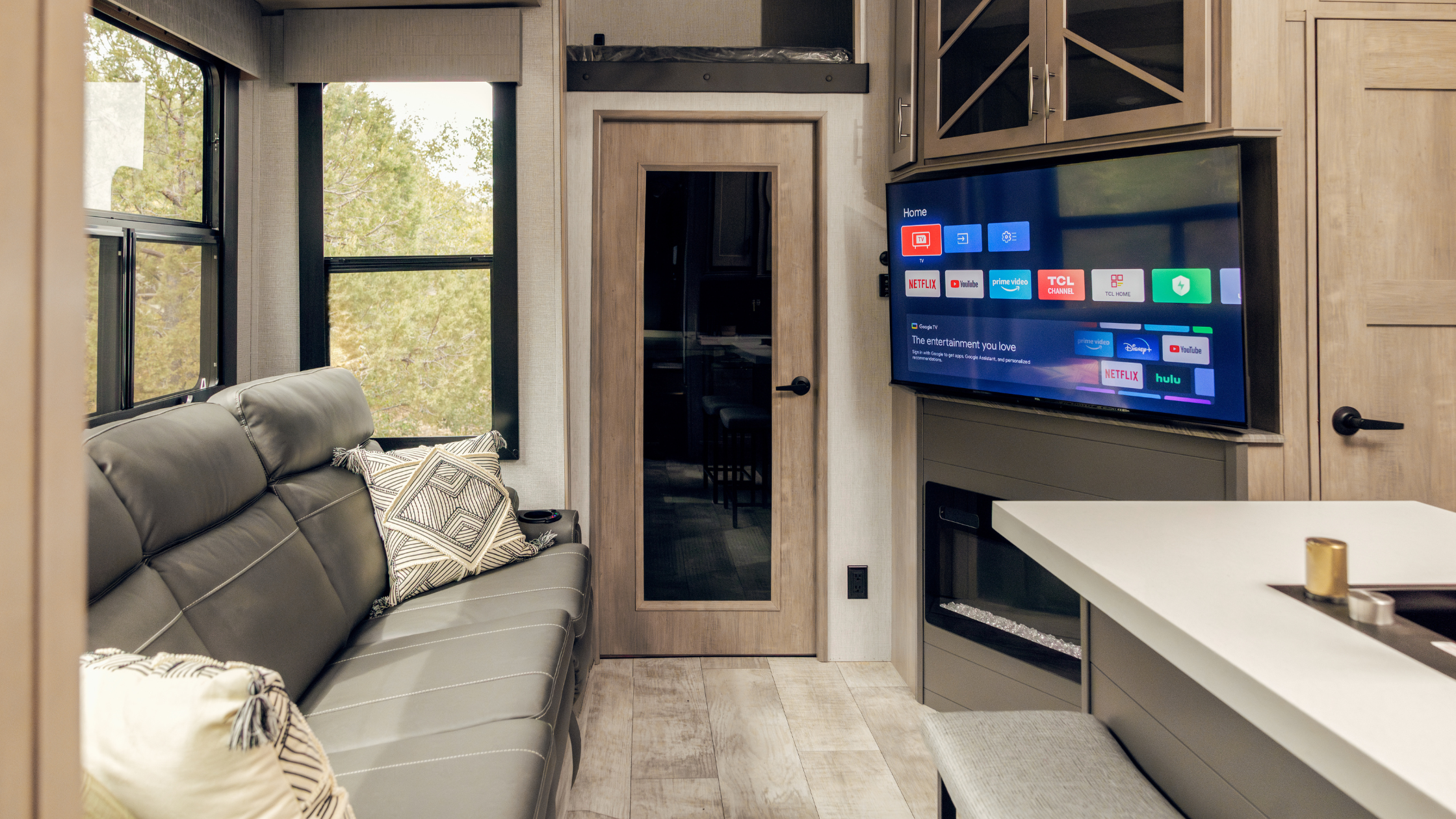
Learn how to live in an RV full-time as we cover financials, travel, and upkeep for your rig.

Full-time RV living allows travelers to explore while maintaining work, routines, and connectivity on the road. Many RVers live full-time in motorhomes or travel trailers to reduce housing costs, gain mobility, or embrace a more flexible lifestyle. This guide explains the real costs of RV living, how people work remotely while traveling, what equipment you need to get started, and how to plan a sustainable life on the road.
In This Guide
-
What Is Full-Time RV Living?
-
Is Full-Time RV Living Right for You?
-
How Much Does Full-Time RV Living Cost?
-
How RVers Make Money While Traveling
-
Can You Work Remotely While Living in an RV Full-Time?
-
Internet for Full-Time RV Living
-
Essential Equipment for Full-Time RV Living
-
How to Plan Your RV Travel Lifestyle
-
Common Challenges of RV Living (and How to Solve Them)
-
Tips for Starting Full-Time RV Life
-
Frequently Asked Questions
-
Final Thoughts: Is Full-Time RV Living Worth It?
What Is Full-Time RV Living?
Full-time RV living means your RV is your home. Your mail forwards to a service, your driver's license points to a domicile state you may not actually spend much time in, and your home address changes alongside the seasons. Some full-timers stay mostly in one region and take longer trips from that home base. Others go all over the country following good weather.
The transition from "RV as toy" to "RV as home" has really taken off. People pick full-time life for all kinds of reasons (like a lower cost of living, travel flexibility, simpler stuff, minimalism, and an escape from a housing market). What they have in common is treating the RV as a home, which means it gets maintained, insured, and geared up like one.
|
Lifestyle |
What it means |
|
Full-time RV living |
RV is the primary residence; no traditional home base |
|
Seasonal RV travel |
Travel medium- or long-term part of the year (3–6 months) |
|
Occasional camping |
Short recreational trips; you live somewhere else |
Is Full-Time RV Living Right for You?
Full-time life isn't for everyone, and that's perfectly fine. The people who like it best don’t mind a bit of change, can work from their rig, love the outdoors, and only need a small space.
Freedom and Flexibility
The biggest upside is a flexible lifestyle. When your home has wheels, you follow weather, visit family, chase seasonal work, or park near a favorite trailhead for a week. You trade commute time and house chores for drive time and rig maintenance, but that’s a trade most full-timers say dramatically plays in their favor.
Downsizing and Minimalism
Moving from a house or apartment into an RV means big decisions about what you’re keeping, and every full-timer goes through this downsize. Most full-timers say the process is enlightening rather than painful, and you discover quickly what you actually use vs. what you keep around because you “might.”
Constant Travel vs. Stability
Some full-timers move every few days, and others park at monthly rates for a season and only move four times a year. Choose a travel format that fits your work, your relationships, your finances, and your energy (and expect it to change over your first year).
Work and Income Considerations
Income makes or breaks your ability to live full-time on the road. Retirees with pensions, remote employees at steady companies, freelancers, and people who've built location-independent businesses all make it work. What doesn't work is assuming you'll "figure out income on the road."
All of the above considered, here’s our list of the biggest RV lifestyle pros and cons for you to weigh for yourself.
|
Pros |
Cons |
|
Lower monthly housing expenses (often) |
Fuel, repairs, and insurance add up |
|
Travel flexibility |
Constant small logistics (reservations, hookups, dump stations, etc.) |
|
Easy to travel to national parks, plus outdoor living |
Weather extremes (heat waves, cold snaps, severe storms, smoke) |
|
Simpler lifestyle and less stuff |
Small living space, especially for families |
|
Built-in community of other full-timers |
Distance from friends and family back home |
|
Tax flexibility (with the right domicile) |
Healthcare, mail, and banking logistics |
How Much Does Full-Time RV Living Cost?
It depends on your rig, how often you move, and how much you cook versus eat out. Most full-time RV budgets land between $1,500 and $5,000+ per month.
RV Purchase or Financing
Class A motorhomes start around $100K and run well past $500K for a luxury coach. Class C motorhomes go for $75,000-$175,000. Travel trailers can be had for $20K-$80K depending on size. Van conversions can be anywhere from $40,000 to $200,000. Used cuts those numbers by 30-60%, but pay for a professional inspection.
Campground and Park Fees
Nightly rates at private campgrounds run $45-$100+. Monthly rates at RV parks drop that to $600-$1,500/month, sometimes with electricity billed separately. State and national park campgrounds average $20-$50/night, but they cap stays at around 14 days. Free dispersed camping on BLM and Forest Service land is $0, with the tradeoff that you bring your own everything.
Fuel and Travel Costs
This is probably the biggest variable in the whole budget. A Class A diesel pusher might get 8 MPG. A minivan conversion might get 20. At $4/gallon, a 300-mile travel day in a Class A runs about $150, while a van runs about $60.
Insurance and Maintenance
Full-timer RV insurance runs $1,000-$3,500/year depending on rig value and coverage. Plan to spend 5-10% of rig value annually on maintenance, including tires, brakes, slide-out service, roof sealing, and the occasional surprise repair.
Internet and Connectivity Costs
Plan for $50-$150/month for cellular data, another $120-$150/month for Starlink Roam if you add it, a one-time $150-$600 for routers or boosters, and the occasional $20 day-pass for a campground network when you need it. Connectivity is a necessity for full-time RVers.
If you love a chart like we do, here’s what that all looks like on a monthly budget:
|
Expense |
Typical Monthly Cost |
|
Campgrounds / parking |
$0-$1,500+ |
|
Fuel |
$150-$800 |
|
RV insurance |
$85-$300 |
|
Maintenance and repairs |
$100-$400 |
|
Internet and connectivity |
$50-$300 |
|
Propane and utilities |
$30-$100 |
|
Food and groceries |
$400-$1,000 |
|
Health insurance |
$200-$1,500 |
|
Phone plans |
$50-$200 |
Most full-timers land somewhere between $2,500 and $5,000 a month. That's generally less than renting a comparable home in a coastal metro, more than renting in a small Midwest town, and almost always more than people think it'll be when they make the shift to full-timing.

How RVers Make Money While Traveling
Full-time RV life is open to anyone whose income doesn't require a physical office.
Remote Jobs
Full-time W-2 employment with a company that allows remote work is often the most common income profile among newer full-timers. Tech, marketing, customer service, design, project management, and operations roles dominate the list. Our best digital nomad RV lifestyle jobs guide gives you some salaries and suggestions on how to land one of these gigs.
Freelancing
Freelance graphic design, development, writing, bookkeeping, consulting, and photography are the road life favorites. Freelancing trades corporate stability for schedule flexibility, which works surprisingly well for RV life, e.g., you can take a Tuesday off to drive a scenic route and make it up Saturday.
Seasonal Work
“Workamping” (or work camping) is the RV world's answer to gig income. Campgrounds, Amazon's CamperForce, sugar beet harvest, and national park concessions all hire seasonal workers who live on-site in their rig. The pay is modest, but the campsite (and often hookups) come included.
Online Businesses
E-commerce, content creation, courses, membership communities, SaaS, and service businesses all run just fine from an RV. Plenty of full-timers run their entire company from a dinette, with team calls happening from whatever campground they pulled into that week.
For income paths that don't need a laptop, read unique ways to fund life on the road.
Can You Work Remotely While Living in an RV?
Well, if you’ve made it this far in the article, you know that answer is yes, but the details matter. Plan for a cellular router with a generous data plan as your primary connection, plus a backup (a second-carrier hotspot or satellite). Video calls need 5-10 Mbps. Cloud-heavy work warrants 10-25 Mbps or more.
|
Activity |
Recommended Speed |
|
Video calls |
5–10 Mbps down / 3 Mbps up |
|
Cloud work |
10–25 Mbps |
|
Streaming |
15+ Mbps |
|
Heavy uploads/video editing |
25–50+ Mbps |
Setups range from a laptop on the dinette to a full mounted monitor, swivel desk, external keyboard, and ergonomic chair setup.
Productivity comes down to routines, a dedicated workspace, protected work hours, and campsite choices that boast the best signal. The 3-3-3 rule (drive no more than 300 miles, arrive by 3 p.m., stay at least three nights) keeps travel days from blending with work days, a mistake almost every new full-timer makes at least once.
Internet for Full-Time RV Living
Connectivity is the most important decision after picking your rig, and most full-timers layer multiple connections rather than betting on one.
Cellular Internet
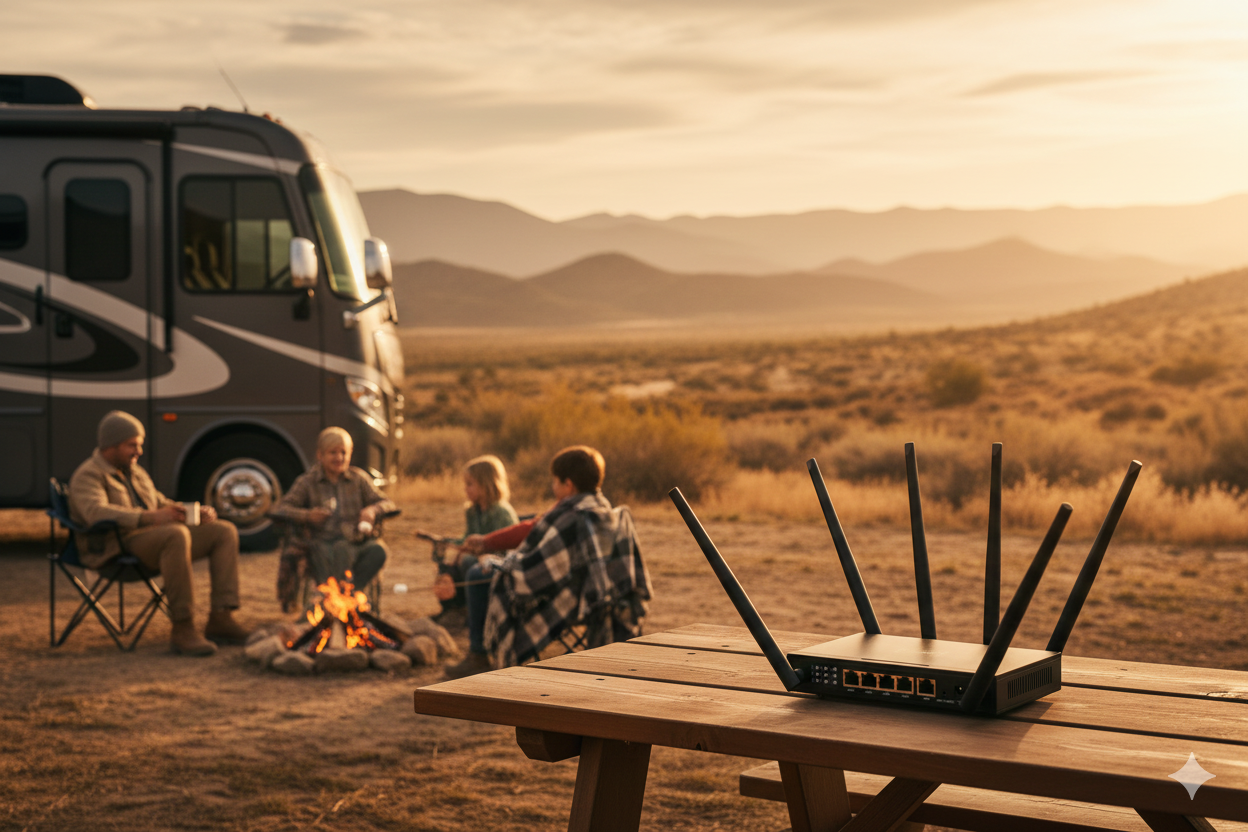
A cellular router (TravlFi XTR Pro 5G, or for something more portable, the JourneyGo hotspot) pulls from multiple carrier networks to use the best available signal at your site. Pay-as-you-go data plans (like you typically have on your phone) skip the contract madness of traditional ISPs.
Satellite Internet
Starlink Roam fills the gaps where cell towers don't reach. It's more expensive (~$150/month plus hardware) but works almost anywhere with a clear sky view. Plenty of full-timers run cellular as primary and Starlink as backup for remote travel.
Campground Wi-Fi
Campground Wi-Fi connections are really only usable for light browsing. Don't count on them for video calls, big uploads, or anything critical. We basically think of it as a free bonus when it’s actually working.
Redundancy is the whole point, and it’s important when you’re working from your RV. A layered stack of RV internet options (cellular primary, second-carrier hotspot backup, satellite off-grid travel or drops in service, campground Wi-Fi as the freebie) keeps you working when one or two modes of connection fail.
Essential Equipment for Full-Time RV Living
Just like there are things you need to make your living situation in a house comfortable and safe, the same thing goes for RV life.
RV Types (Motorhome vs. Travel Trailer)
-
Class A motorhomes: Biggest and most house-like, best for couples and full-timers who want space, but not great on tight roads.
-
Class B vans: Smallest and easiest to drive, and are best for solo travelers and couples who move often.
-
Class C motorhomes: Easier to drive than a Class A, more space than a Class B.
-
Travel trailers: Tow-behind, which means you can detach your tow vehicle at camp and run errands without packing up.
-
Fifth wheels: Larger tow-behind option popular with full-timers, but requires a heavy-duty truck.
Solar and Power Systems
Full-timers who boondock regularly install solar panels (200-600W+) plus a lithium battery bank (typically 200-600Ah). Shore power is enough if you stay at hookup sites, but plan to spend $3,000-$10,000 for an off-grid setup.
Water and Waste Systems
Fresh, gray, and black tank capacities determine how long you can boondock between fills and dumps. A water filter at the spigot extends your appliance life. Learn the sanitation routine for your black tank before your first trip though; it's not complicated, but it's brutal when you skip a step.
Connectivity Equipment
Cellular router, optional booster, satellite messenger, and a mobile-office setup that doesn't ruin your back. See our mobile office upgrades for digital nomads for a full gear roundup.
A few more essentials worth bookmarking: RV must-have accessories, essential winter vanlife gear, and an overlanding emergency kit if your travel pulls you off the beaten path.

How to Plan Your RV Travel Lifestyle
You’ll plan similarly to how you plan a week-long RV trip, but you’ll need to consider full-time necessities (like a mailing address, long-term stay options, routes that will save your sanity, etc.).
Choosing Destinations
Weather dictates most RV full-timer routes. Cool in the north in summer, warm in the south in winter, shoulder seasons in spring and fall. Throw in work commitments (conferences, events, in-office appearances, retreats) and personal preferences (hiking, fishing, time near the grandkids, the occasional concert), and the calendar mostly builds itself.
Finding Campgrounds
RV Trip Wizard, Campendium, The Dyrt, Hipcamp, Harvest Hosts, Boondockers Welcome, plus the reservation systems for state and national parks (Recreation.gov, ReserveAmerica) are the main tools you’ll want to bookmark. Book national park and popular state park sites months in advance. The spots everyone loves most can literally disappear 90 seconds after their reservation window opens (Yosemite, we see you).
Planning Travel Routes
Use RV-specific GPS apps (RV LIFE, Garmin RV, CoPilot, and Sygic Truck) that account for your rig's height, weight, and length. A regular car GPS will route you under low bridges, into one-way mountain passes, and onto roads that RVs aren’t even allowed on. The 3-3-3 rule keeps your pace sustainable when you're new to long travel days.
Managing Mail and Residency
Pick a domicile state (Florida, South Dakota, Texas, and Tennessee are popular for low or no state income tax) and sign up for a mail forwarding service like Escapees, America's Mailbox, St. Brendan's Isle, or Traveling Mailbox. Your driver's license, vehicle registration, and voting all follow that domicile.
Common Challenges of RV Living (and How to Solve Them)
Where do full-time RVers park?
They park in a mix of private RV parks, state and national parks, BLM dispersed camping, Forest Service sites, Harvest Hosts (wineries, farms, breweries), and the occasional Walmart or Cracker Barrel (personally, we don’t hate this one) overnight when between locations. Most full-timers have a running list of favorites in every region they travel to.
How do RVers get mail?
They use mail forwarding services with a physical address in a tax-friendly state. They receive your mail, send you a photo of each piece, and forward what you actually want opened. The rest sits in storage or gets shredded, depending on your preference.
How do RVers handle internet access?
Primary cellular, second-carrier backup hotspot, Starlink as needed, campground Wi-Fi for browsing. We really love redundancy at TravlFi.
What happens if the RV breaks down?
Good Sam, AAA RV, Coach-Net, and FMCA Roadside Rescue all offer roadside assistance for RVs. Mobile RV mechanics can come to you for a lot of repairs. For more extensive jobs, expect to head to a dealer or RV-specific service location, and add that extra time into your travel schedule.
For more common pitfalls, see our common RV mistakes guide. For seasonal extremes, how to keep your RV cool during summer and the winter vanlife guide cover the edges.
Tips for Starting Full-Time RV Life
Downsize gradually. Start selling, donating, or storing months before your move date. The process takes longer than you may expect and gets emotional when you run across items you struggle to part with.
Test RV travel with shorter trips. Rent a rig for a long weekend, then a full week, then two weeks, and so on. When you commit to full-time, you've already run into most of the early problems and lessons RVers face.
Save for unexpected costs. Build a 3-6 month emergency fund that sits safely in a savings account. First-year full-timers almost always hit a couple of surprise repair bills.
Build a reliable internet setup. If you're working remotely in an RV, this is priority number one. Get it right before you leave, so you aren’t double-paying for internet while you’re still able to use your house Wi-Fi.
Start with a "home base" rhythm. A lot of first-year full-time RVers pick a home state or region, and take longer trips from there, instead of going full nomad on day one. This makes for an easier transition.
Frequently Asked Questions
How much does it cost to live in an RV full time?
Most full-timers spend $2,500-$5,000/month, including campgrounds, fuel, repairs, internet, food, and rig/health insurance. The range is honestly pretty wide, with lean boondocking couples hitting $1,500/month, and luxury coach travelers on full hookups pushing $7,000.
Can you work remotely from an RV?
Yes, but you need a location-independent job, a reliable cellular internet setup (ideally with a satellite backup), a dedicated work area, and a schedule separating work hours from your travel hours.
Is RV living cheaper than a house?
It's often cheaper than renting on either coast or buying at current mortgage rates, but fuel, repairs, and insurance rates can close that gap quicker than you may expect.
Where do full-time RVers park?
Private RV parks, state and national parks, BLM dispersed sites, Forest Service campgrounds, Harvest Hosts, Boondockers Welcome, and the occasional overnight lot. Long monthly stays at a single park are common for full-timers who work.
Do RVers have reliable internet?
A layered plan (cellular primary, satellite backup) delivers consistent connectivity in most locations. Campground Wi-Fi alone is not reliable—need we say it again?
Final Thoughts: Is Full-Time RV Living Worth It?
Full-time RV life works best for people who like flexibility, travel, simplicity, and outdoor access. Any problem you had in a house comes with you, sometimes in tighter quarters (and with the complications of being on wheels), but it's a legitimately different way to live, and people who plan for it tend to love it. The ones who don’t plan, well, they don’t fare as well.
Start with a week-long test trip. See how it feels to live out of your rig, handle daily logistics, work on the road, and live in a small space. Then take it from there.
Which TravlFi Device Is Right for You?
TravlFi keeps you connected on the road. Not sure which device is best for your setup? Compare below.

Learn more about TravlFi devices and pay-as-you-go data plans before you hit the road full-time.



Share:
Is RV WiFi Any Good? The Honest Truth From Real-World Use
Seeking Freedom, Young Adults Fuel RV Lifestyle Boom—But the New American Dream Isn't All Perks