


Do RVs Have Wi-Fi? The Honest Answer for Travelers and Remote Workers

In This Article
Whether RV and campground Wi-Fi is actually usable
Why campground Wi-Fi often performs poorly
How different RV internet options compare
What setup works best for streaming or remote work
How to evaluate Wi-Fi quality while traveling
FAQs
Do RVs have Wi-Fi? Yes, but “RV Wi-Fi” is an umbrella term, not one guaranteed service. You can get internet in your RV through campground Wi-Fi, a phone or dedicated hotspot, a cellular router, or satellite internet. The right choice comes down to where you camp, how many devices you use, and whether you need to work online.
Many RV parks have Wi-Fi, but that does not automatically mean it is ready for streaming, video calls, or a workday. Think of campground Wi-Fi as a useful amenity to test on arrival. For a setup you can plan around, compare it with a dedicated RV Wi-Fi option that fits your travel style.
TL;DR
RV Wi-Fi can be excellent, but it depends on the connection behind it. Campground Wi-Fi is often fine for light browsing and a backup, while cellular hotspots and routers are a more predictable everyday choice when coverage is good. Satellite can add reach in remote places with a clear view of the sky. Test the network where you are parked, and keep a backup if you work or stream on the road.
Experts Who Contributed to This Guide
Monika Geraci, spokesperson for Go RVing and the RV Industry Association, contributed expertise to this article.
This article was reviewed for accuracy by Jeff Gwinnell, mobile connectivity specialist at TravlFi.
Amanda Capritto, the author of this guide, lived and traveled in a camper van for two years while also running a full-time freelance business. She's used most of the top RV Wi-Fi solutions.

RV Wi-Fi Options: What's Available?
When it comes to getting internet in your RV, you have a few options:
Public Wi-Fi: Available at many campgrounds, cafes, and visitor centers, but often slow, unsecured, and unreliable. However, "Many parks are investing in infrastructure upgrades to enhance the user experience for quicker streaming and remote working," says Geraci.
Phones and mobile hotspots: Uses a phone's cellular network to provide internet access. Or, a separate battery-powered handheld device with its own data plan. Speeds and reliability depend on carrier coverage, but for the most part, they provide "fantastic speed and reliability in a growing number of areas thanks to expanding cellular networks," according to Geraci. "While data plans are a consideration, convenience and performance often make it a worthwhile choice for staying connected on the go."
Cellular routers: Similar to your router at home, a cellular router is a comprehensive solution that provides more features, faster connectivity, a stronger signal and supports more device connections than a hotspot. Cellular routers support wired connections too. (Read also: the difference between a hotspot and a mobile router.)
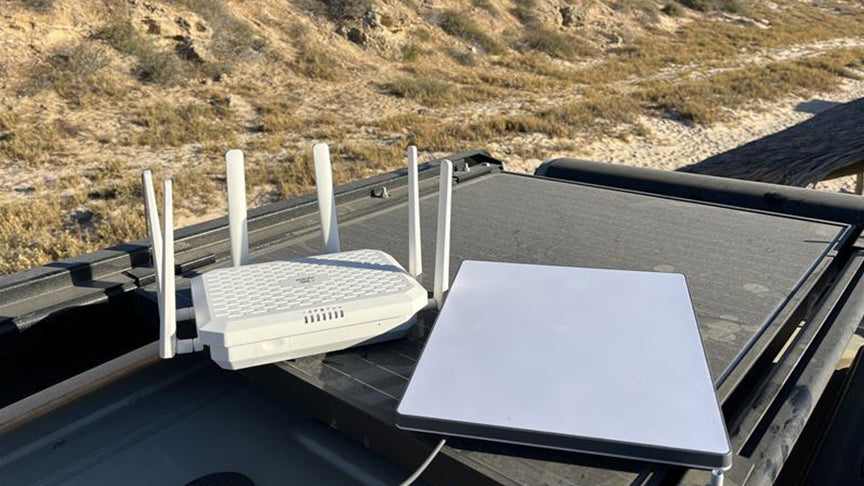
Satellite internet: Offers connectivity in off-grid areas but is often more expensive and subject to aerial obstructions like trees and buildings. Satellite options like Starlink "open up a world of connectivity in more remote locations, offering reliability where other options might be limited," says Geraci.
Many RVers, myself included, use a combination of these options, choosing the best one based on location and internet needs. I have found that a cellular hotspot for everyday use and satellite internet for off-grid travel provides a more dependable overall plan than relying on a single network.
A quick RV internet decision guide
Basic browsing and occasional weekends: Test campground Wi-Fi first, then use a phone hotspot as a simple backup.
Remote work and regular streaming: A dedicated cellular hotspot or router with a data plan you understand is usually the more predictable starting point.
Several connected devices: A cellular router can make it easier to share one connection throughout the RV and keep devices on the same local network.
Remote or off-grid travel: Consider satellite as another connection path, with the understanding that trees, terrain, weather, and a clear view of the sky still matter.
Is RV WiFi Any Good?
RV Wi-Fi can be very good when the connection matches the job. The phrase covers several different things: campground Wi-Fi, a local Wi-Fi network created by your cellular hotspot or router, and satellite internet. A disappointing campground network does not mean every RV internet option is disappointing.
That said, no mobile setup is as fixed or uniform as a home connection. Coverage, network congestion, terrain, the distance to a campground access point, and your data plan all affect the experience. The most reliable RVers plan for the work they actually need to do and avoid treating one source as a promise everywhere they travel.
Why campground Wi-Fi can be unpredictable
Campground Wi-Fi is convenient when it works, especially for email, browsing, maps, or a quick download. It is also shared infrastructure. A network can slow down when many guests connect at once, when access points are far from your site, or when the park has limited backhaul capacity. A resort with reliable Wi-Fi may be a great stop, but it is wise to test it before you schedule a video call around it.
What helps RV Wi-Fi feel more reliable
Check cellular coverage and data-plan terms before committing to a work stop.
Test a campground connection from your actual site, including during busier evening hours.
Keep a backup connection if you work remotely, stream often, or travel away from larger towns.
Use a booster or extender only for the specific problem it is designed to solve; it cannot create coverage or add bandwidth that does not exist.
RV Wi-Fi vs. Residential Internet
Though the mechanisms providing internet access differ, what you experience with RV Wi-Fi can feel more or less the same as home internet, particularly if you invest in a mobile router or hotspot device with a substantial data plan.
Many RVers use a phone hotspot for a simple connection, while others add a dedicated hotspot or cellular router for more control over device sharing and data use. Those setups can handle streaming and remote work when the underlying cellular connection and data plan are up to the task.
"However, RV Wi-Fi offers the unique advantage of portability providing access in remote locations," Geraci points out. "Plus, with the variety of options available, RVers can often find solutions that perfectly suit their travel style and data needs."
Unlike home internet, though, there is naturally more instability as far as connection quality. How well your system works at any given time depends on factors like proximity to cell towers, network congestion, and terrain—all things that are more constant in a residential home environment.

How to Get Good Wi-Fi In Your RV
The most important step in optimizing your RV Wi-Fi connection is choosing a setup that fits your travel style. If you mostly take short trips and stay at established parks, a phone hotspot and tested campground Wi-Fi may be enough. If you work online or travel frequently, build your setup around a dedicated cellular connection and a realistic data plan.
Choose your primary connection: cellular is a practical everyday option in areas with coverage; satellite can add reach in remote places with a clear view of the sky.
Match data to behavior: compare plan details with the video calls, streaming, updates, and number of devices you actually use.
Use the right hardware: a router can make sense for several devices or a more permanent setup. Read our comparison of a mobile hotspot versus a phone hotspot before deciding.
Plan a backup: a second cellular option, a phone hotspot, or satellite can be more useful than expecting campground Wi-Fi to carry every task.
"Optimizing your setup can be as easy as strategically placing your router for better signal distribution within your RV," says Geraci. "For cellular hotspot users, understanding the direction of the nearest cell tower can sometimes make a difference."
Sometimes, placing it outside (if the weather is nice) can make an even bigger difference. For satellite internet, be sure to check the alignment and park in an area free from obstructions.
The Future of RV Internet
Good news: With more and more people purchasing RVs—and living in them full-time—we can only expect the technology to get better.
"We anticipate significant advancements on several fronts, making it even easier to stay connected while enjoying the great outdoors," says Geraci. The continued expansion and increased affordability of 5G cellular networks will be transformative for RVers, bringing much faster speeds and lower latency to more locations across the country.
According to Geraci, this will make activities like streaming, video conferencing, and online gaming smoother than ever.
"We're also very optimistic about the progress in low-Earth orbit (LEO) satellite internet services, like Starlink. These are poised to offer broader coverage and improved performance, particularly in more remote areas where traditional cellular signals may be weaker," Geraci continues.
Notably, Geraci expects to see more RVs equipped with integrated multi-network solutions that can seamlessly switch between cellular, Wi-Fi, and satellite for the best available connection.
And if you don't want to invest in an RV Wi-Fi setup, you'll be pleased to hear that "campground owners are increasingly recognizing the demand for reliable internet access and are investing in upgrades to their systems," according to Geraci.
"We anticipate more campgrounds offering higher bandwidth and more robust Wi-Fi networks to better serve their guests," she says. "Similarly, there's a growing awareness of the need for connectivity in national and state parks."
How to Judge RV Wi-Fi Performance Yourself
When testing RV Wi-Fi from any source, look beyond the first download-speed result:
Run tests at more than one time of day, including the evening when a campground may be busiest.
Check download speed, upload speed, and latency; video calls depend on all three.
Try the activities you actually need, such as a short video call, a large upload, or streaming on more than one device.
Move around the RV and, where appropriate, test a different parking position or the outdoor placement recommended for your equipment.
Confirm data-plan limits, deprioritization, and hotspot allowances before relying on a connection for a long stay.
Gwinnell’s reminder still applies: even moderate speeds can feel unusable when latency is high or the connection is inconsistent.
FAQs
Can I use campground Wi-Fi for remote work?
Maybe, but test it before you rely on it. Campground Wi-Fi can be perfectly usable for lighter tasks, yet the experience changes by park, site location, time of day, and how many guests are online. For meetings or deadline-sensitive work, keep a cellular or satellite backup.
Do I need a router for RV Wi-Fi?
Not always. A phone hotspot can be enough for one person with light internet needs. A dedicated hotspot or router becomes more useful when you connect several devices, want a fixed in-RV network, need wired options, or prefer more control over your setup.
Do RV parks have Wi-Fi?
Many RV parks advertise Wi-Fi, but the quality varies. Ask whether it reaches individual sites, whether there are known busy periods, and whether the park recommends it for streaming or video calls. Treat a “Wi-Fi available” listing as a starting point rather than a performance guarantee.
What is a good backup internet option for an RV?
The best backup is a different connection path from your primary one. For example, pair a dedicated cellular hotspot or router with a phone hotspot on another carrier when possible, or add satellite for remote travel. The goal is not to own every option; it is to avoid one outage ending your workday.
How much does RV Wi-Fi cost?
Costs depend on the hardware, the amount of data you need, and whether you use cellular, satellite, or both. Compare the full monthly plan terms, including data allowances and hotspot rules, rather than choosing only by the lowest advertised price.
More Essential Reading for RVers:
Which TravlFi Device Is Right for You?
TravlFi keeps you connected on the road. Not sure which device is best for you? Compare below.

Wherever your travels take you, TravlFi's flexible data plans and powerful hotspot devices will keep you connected.
What campground Wi-Fi can (and can't) handle, why it's often unreliable, and what works better for RV travelers and remote workers.
In This Article
-
Whether RV and campground Wi-Fi is actually usable
-
Why campground Wi-Fi often performs poorly
-
How different RV internet options compare
-
What setup works best for streaming or remote work
-
How to evaluate Wi-Fi quality while traveling
-
FAQs
Preparing to hit the road in your RV takes significant time and energy to research the best options for fuel stops, grocery stores, sights to see, and, if you're boondocking, safe (and ideally scenic) places to sleep. Figuring out where to park, dump your black and gray tanks, and checking weather and road conditions are all items to check off your to-do list before pulling out of the driveway.
Having Wi-Fi on the go makes everything easier. A reliable internet connection can help with navigation, allow passengers to research locations on the fly, and ensure a backup plan is always within reach if things don't go as expected—and any seasoned RVer knows they won't. The question is: Is RV Wi-Fi any good?
TL;DR
Campground Wi-Fi is usually unreliable, especially in busy parks or off-grid spots. It's fine for basic browsing or checking email, but don't count on it for video calls or steady remote work. Most RVers lean on cellular data with campground Wi-Fi as a backup. I spoke with Monika Geraci, spokesperson for Go RVing and the RV Industry Association, and added my experience as a full-time vanlifer for the full picture of modern RV Wi-Fi options.
Experts Who Contributed to This Guide
-
Monika Geraci, spokesperson for Go RVing and the RV Industry Association, contributed expertise to this article.
-
This article was reviewed for accuracy by Jeff Gwinnell, mobile connectivity specialist at TravlFi.
-
Amanda Capritto, the author of this guide, lived and traveled in a camper van for two years while also running a full-time freelance business. She's used most of the top RV Wi-Fi solutions.
RV Wi-Fi Options: What's Available?
When it comes to getting internet in your RV, you have a few options:
-
Public Wi-Fi: Available at many campgrounds, cafes, and visitor centers, but often slow, unsecured, and unreliable. However, "Many parks are investing in infrastructure upgrades to enhance the user experience for quicker streaming and remote working," says Geraci.
-
Phones and mobile hotspots: Uses a phone's cellular network to provide internet access. Or, a separate battery-powered handheld device with its own data plan. Speeds and reliability depend on carrier coverage, but for the most part, they provide "fantastic speed and reliability in a growing number of areas thanks to expanding cellular networks," according to Geraci. "While data plans are a consideration, convenience and performance often make it a worthwhile choice for staying connected on the go."
-
Cellular routers: Similar to your router at home, a cellular router is a comprehensive solution that provides more features, faster connectivity, a stronger signal and supports more device connections than a hotspot. Cellular routers support wired connections too. (Read also: the difference between a hotspot and a mobile router.)
-
Satellite internet: Offers connectivity in off-grid areas but is often more expensive and subject to aerial obstructions like trees and buildings. Satellite options like Starlink "open up a world of connectivity in more remote locations, offering reliability where other options might be limited," says Geraci.
Many RVers, myself included, use a combination of these options, choosing the best one based on their location and internet needs. I've found that a combined setup—like a cellular hotspot for everyday use and satellite internet for off-grid travel—gives me the best coverage.
Common Misconceptions About RV Wi-Fi
One of the biggest misconceptions about RV Wi-Fi is that it's inherently unreliable. "While it's true that RV Wi-Fi operates differently than a fixed home setup, the advancements we're seeing are impressive," says Geraci. "[There are] a wide range of internet options ensuring that RVers can tailor their connectivity to their specific needs and destinations."
Geraci says that, according to RVIA research, 22 percent of today's RV owners work remotely, with 54 percent of them doing so from their RV. In other words, there's a lot of motivation for RV internet providers to manufacture good products—staying connected on the road has become more than a nicety. It's critical for those who live as digital nomads, so the technology has been advancing rapidly.
Why Campground Wi-Fi Is Often Slow
If you typically rely on campground Wi-Fi, you might wonder why it's often so finicky. Common reasons campground Wi-Fi underperforms include:
-
Dozens (or hundreds) of users on one network
-
Limited bandwidth purchased by the campground
-
Poor router placement and outdated equipment
-
Long distances between access points and RV sites
-
Peak-hour congestion in the evenings
Common RV Wi-Fi Mistakes
-
Relying on campground Wi-Fi for remote work
-
Assuming "Wi-Fi available" means "high-speed"
-
Parking far from access points without testing
-
Using Wi-Fi boosters for public Wi-Fi instead of investing in cellular or satellite solutions
-
Not having a backup internet option
RV Wi-Fi vs. Residential Internet
Though the mechanisms providing internet access differ, what you experience with RV Wi-Fi can feel more or less the same as home internet, particularly if you invest in a mobile router or hotspot device with a substantial data plan.
Geraci says that most RV owners (56 percent, according to RVIA data) use their phone as a hotspot while traveling in their RV, while 42 percent of RVers use built-in Wi-Fi systems that functionally operate just like residential Wi-Fi. These systems feature the same capabilities to stream entertainment and support remote work.
"However, RV Wi-Fi offers the unique advantage of portability providing access in remote locations," Geraci points out. "Plus, with the variety of options available, RVers can often find solutions that perfectly suit their travel style and data needs."
Unlike home internet, though, there is naturally more instability as far as connection quality. How well your system works at any given time depends on factors like proximity to cell towers, network congestion, and terrain—all things that are more constant in a residential home environment.
How to Get Good Wi-Fi In Your RV
The most important step in optimizing your RV Wi-Fi connection is choosing the setup that makes sense for your travel style. If you plan to camp exclusively in resorts and established campgrounds, you may not need to invest in a setup at all.
"In many campgrounds, Wi-Fi infrastructure is constantly being upgraded, offering more robust connections for those 32 percent of RVers using campground Wi-Fi when traveling," says Geraci.
"For those venturing further afield, cellular hotspots provide reliable internet in many areas, and satellite technology is expanding its reach and improving its performance," she continues. If you're unsure whether cellular-based internet or satellite internet is best for you, read our guide to hotspots versus Starlink.
Additionally, purchasing a data plan that makes sense for your usage is key. If you're a remote worker who also loves Netflix nights in or you've gotta watch the big game every week, an unlimited plan is likely best for you. An RV Wi-Fi booster helps with cellular signal when you're on the fringes of civilization, too.
"Optimizing your setup can be as easy as strategically placing your router for better signal distribution within your RV," says Geraci. "For cellular hotspot users, understanding the direction of the nearest cell tower can sometimes make a difference."
Sometimes, placing it outside (if the weather is nice) can make an even bigger difference. For satellite internet, be sure to check the alignment and park in an area free from obstructions.
The Future of RV Internet
Good news: With more and more people purchasing RVs—and living in them full-time—we can only expect the technology to get better.
"We anticipate significant advancements on several fronts, making it even easier to stay connected while enjoying the great outdoors," says Geraci. The continued expansion and increased affordability of 5G cellular networks will be transformative for RVers, bringing much faster speeds and lower latency to more locations across the country.
According to Geraci, this will make activities like streaming, video conferencing, and online gaming smoother than ever.
"We're also very optimistic about the progress in low-Earth orbit (LEO) satellite internet services, like Starlink. These are poised to offer broader coverage and improved performance, particularly in more remote areas where traditional cellular signals may be weaker," Geraci continues.
Notably, Geraci expects to see more RVs equipped with integrated multi-network solutions that can seamlessly switch between cellular, Wi-Fi, and satellite for the best available connection.
And if you don't want to invest in an RV Wi-Fi setup, you'll be pleased to hear that "campground owners are increasingly recognizing the demand for reliable internet access and are investing in upgrades to their systems," according to Geraci.
"We anticipate more campgrounds offering higher bandwidth and more robust Wi-Fi networks to better serve their guests," she says. "Similarly, there's a growing awareness of the need for connectivity in national and state parks."
How to Judge RV Wi-Fi Performance Yourself
When testing RV Wi-Fi from any source:
-
Run speed tests at different times of day
-
Test both download speed and latency
-
Try connecting from multiple locations inside the RV
-
Check performance during peak evening hours
-
Verify upload speeds for video calls
Gwinnell reminds: Even moderate speeds can feel unusable if latency is high.
FAQs
What is the best Wi-Fi for campers?
It really depends on your travel style and needs. Someone who travels in their RV part-time and stays in established campgrounds may not need a Wi-Fi system at all. For someone who boondocks in remote areas and needs to stay connected for work, multiple systems might be necessary. For me, a full-time boondocker, three systems (phone hotspot, cellular router, and Starlink) allow me to work all over the continent regardless of terrain and region.
How does portable internet work?
For the most part, portable internet devices (mobile hotspots and routers) use cellular network signals and convert them into usable Wi-Fi over a local area network (LAN). Aside from such devices, there is also satellite internet, which works by communicating with a network of satellites in Earth's orbit.
How much does RV Wi-Fi cost?
Your wallet need not suffer to get good Wi-Fi in your RV. A membership-free, pay-as-you-go option is the best route because you have full control of how often you use and pay for Wi-Fi in your RV. Many RV internet providers, including TravlFi and Starlink, offer no-contract plans. Actual costs vary based on the hardware you buy and how much data you need per month. For part-time travelers, data plans can cost as low as $10 per month, while unlimited plans can reach upward of $200 per month.
More Essential Reading for RVers:
Which TravlFi Device Is Right for You?
TravlFi keeps you connected on the road. Not sure which device is best for you? Compare below.
Wherever your travels take you, TravlFi's flexible data plans and powerful hotspot devices will keep you connected.


Share: