


Does "unlimited" truly mean unlimited? Let's talk about it.

In This Article
-
What "unlimited" actually means in RV internet
-
How TravlFi's unlimited plans work
-
Unlimited options from T-Mobile, Verizon, AT&T, and other multi-carrier providers
-
Satellite alternatives like Starlink
-
Choosing the right plan for you
-
Side-by-side plan comparison
-
FAQs
Life on the road can be unpredictable, but one thing that shouldn't be is your internet connection. Digital media and remote work are more popular than ever, and it's increasingly important to have an internet connection without anxiety about reaching data caps.
It’s time to dig into the world of unlimited internet for RVs. We'll compare the coverage, pricing, and other strengths and weaknesses of unlimited internet plans for RVs from TravlFi and other major carriers. According to the RV Industry Association, 22% of RV owners now have someone in the household working remotely, with over half doing so from the RV, which makes the RV unlimited data comparison more relevant than ever.
TL;DR
For most RVers, TravlFi's unlimited plans deliver the closest thing to true unlimited RV internet at $129/month with no contract, multi-carrier coverage, and no data caps. T-Mobile AWAY ($160/month) and Verizon work well in their coverage zones, while Starlink ($175/month Roam) wins for off-grid travel. Consider where you camp, how much data you use, and whether you need a backup for cellular dead zones before choosing.
Experts Who Contributed to This Guide
-
Arthur Colker, a networking expert and founder of StayFi, contributed expertise to this article.
-
Donovan Aubert, a Verizon sales specialist, contributed expertise to this article.
-
This article was reviewed for accuracy by Jeff Gwinnell, TravlFi connectivity specialist.
-
This article was originally written by Ever Vigee, experienced travel writer.
-
This article was updated by Lauren Keary, experienced travel journalist.
Understanding "Unlimited" Internet
Unlimited internet gives RVers the ability to stream, conduct remote work, play video games, and do other online activities that could gobble phone data, but with these plans, you don’t have to worry about going over your data limit. Well, for the most part.
Many unlimited data plans are not truly "unlimited." Often, your provider may have throttling policies that decrease your speeds or deprioritize your connection if you use a certain amount of data. When you're working from your RV, that matters — a lot.
True Unlimited vs High-Threshold Unlimited
True unlimited plans, where you can use as much data as you want with no slowdowns or restrictions, are extremely rare for RV-friendly internet. Most so-called unlimited plans are better described as "high-threshold" plans. You get a generous chunk of high-speed data each month, and after you cross that line, your speeds get reduced or your traffic gets pushed to the back of the queue during congestion.
Some carriers throttle at 50GB; others at 400GB. TravlFi's unlimited plans push the threshold to 800GB before any potential speed reduction kicks in, which is closer to true unlimited RV internet than most cellular plans on the market.
Throttling, Deprioritization & Fair Use Policies
A few terms worth knowing before you sign up for any "unlimited" plan:
-
Throttling is when your provider slows your speeds after you cross a data threshold. Speeds drop to a set minimum (often 1-5 Mbps) for the rest of your billing cycle.
-
Deprioritization is a little more subtle. Your data isn't slowed automatically, but if you're connected to a tower with congestion, your traffic gets pushed behind that of other users. You might not notice the difference at 2 a.m., but at 7 p.m. on a Friday, that connection can be glacial.
-
Fair use policies are the catch-all clauses that let carriers throttle, deprioritize, or even cancel service if they decide you're using "too much" data. These exist on basically every plan marketed as unlimited.
-
Soft caps are advertised data limits that aren't hard cutoffs. You can technically keep using data past them, but speeds will slow and performance will drop.
Read the fine print before you commit. A plan that calls itself unlimited at $80/month might be unusable for your travel style if its threshold is 50GB and you stream every night.
How TravlFi's Unlimited Plans Work
TravlFi's unlimited plans are available for all of our devices, including the JourneyGo hotspot, JourneyGo 5G hotspot, and JourneyXTR Pro 5G router. Unlimited plans are priced at $129/month across the lineup.
Multi-Carrier Connectivity & eSIM
You can access the internet from multiple major carriers with eSIM technology, so you get unlimited data from multiple providers for the price of one. TravlFi devices use TowerSync to automatically connect to whichever carrier has the strongest signal in your spot, which means fewer dead zones as you cross state lines and switch coverage areas.
Pay-As-You-Go Flexibility
All TravlFi plans are on a flexible pay-as-you-go basis, and you are not bound by a contract. You can pause, downgrade, or scale up your plan month-to-month based on how much you're traveling. For seasonal RVers, snowbirds, and weekend travelers who don't need data every month, that flexibility means you're not paying for service when your rig is parked.
Data Threshold Realities
Another advantage of TravlFi's unlimited plans is that their extremely high data threshold puts you much closer to a true "unlimited" plan than most other carriers. You would need to use over 800GB of data before potentially experiencing a reduction in speeds. For context, that's enough to stream HD video for around 250 hours, or work from the road for an entire month with plenty of headroom for streaming and downloads on the side.
Performance Expectations
Even if you do hit the 800GB threshold, speeds only reduce to a minimum of 5 Mbps. That's not blazing fast, but it's enough for browsing, email, video calls in standard definition, and basic remote work (plus, speeds return to full at the start of the next billing cycle). But because TravlFi runs off existing major carrier networks, your performance in any given spot is ultimately tied to whichever carrier has signal there.

Unlimited Internet Options Outside TravlFi
For RVers who want to compare options or build a layered setup, several carriers and services offer unlimited or near-unlimited plans that work for life on the road.
Other Multi-Carrier Options
TravlFi isn't the only multi-carrier option out there, though it's one of the few designed specifically for RV travel. A couple of alternatives worth knowing about:
-
Solis (formerly Skyroam) by Simo: A multi-carrier hotspot service that auto-switches between major U.S. networks. Pricing is comparable to TravlFi, but data plans tend to cap below 100GB on their unlimited tiers, which makes it better for light to moderate users.
-
MiFi devices: MiFi is a hotspot category (originally an Inseego trademark) that carriers like Verizon and AT&T resell under their own brands. These devices typically lock to a single carrier's network, so they don't deliver true multi-carrier flexibility, but they can be a solid choice if you already have a strong-coverage carrier and just need a separate device for your rig.
T-Mobile AWAY
T-Mobile's AWAY internet plan is a popular choice for long-term RVers, seasonal travelers, digital nomads, and other frequent travelers, according to T-Mobile's website. The unlimited plan runs $160/month with autopay, with a 200GB tier at $110/month, and both plans include a 5G Wi-Fi Gateway at no extra hardware cost.
Arthur Colker, a networking expert and founder of StayFi, notes that the plan's strengths lie in its flat-rate pricing, and "its aggressive 5G coverage build-out, which can provide excellent speeds in the majority of suburban and urban locations."
He warns, however, that coverage in rural areas may not be quite as strong as Verizon's, posing potential drawbacks for those who depend on a consistent connection for remote work, streaming, or gaming. That said, T-Mobile is also pioneering satellite connections through a partnership with Starlink, so more rural coverage could come soon.
Verizon Cellular
Verizon does not have an internet plan specifically tailored to RVers, but you may still be able to use their products on the road. Donovan Aubert, a Verizon sales specialist, says that Verizon's internet routers can be used at a place of residence and in RVs as long as you have some type of power source.
He notes that the biggest advantage of Verizon for RV use is its coverage across most of the nation, so you stay covered on the move. According to Aubert, you will also not be throttled while connected under Verizon's unlimited plans. Pricing varies depending on whether you're bundling with a phone plan and what promotions Verizon is running at signup, but most setups land in the $20-$80/month range when bundled.
AT&T Plans
AT&T does not have any dedicated RV plans, but their hotspot plans work well for travel in some cases. AT&T's coverage falls in between Verizon and T-Mobile, Colker says, and it's strong in the majority of urban areas, suburban areas, and highway-adjacent zones; however, it's "not quite as solid in very rural areas," which means it’s better for folks who do not strictly travel off the grid, he adds.
Learn more about cellular hotspots: How to Get Internet in an RV (Wi-Fi, Satellite & More).
Starlink
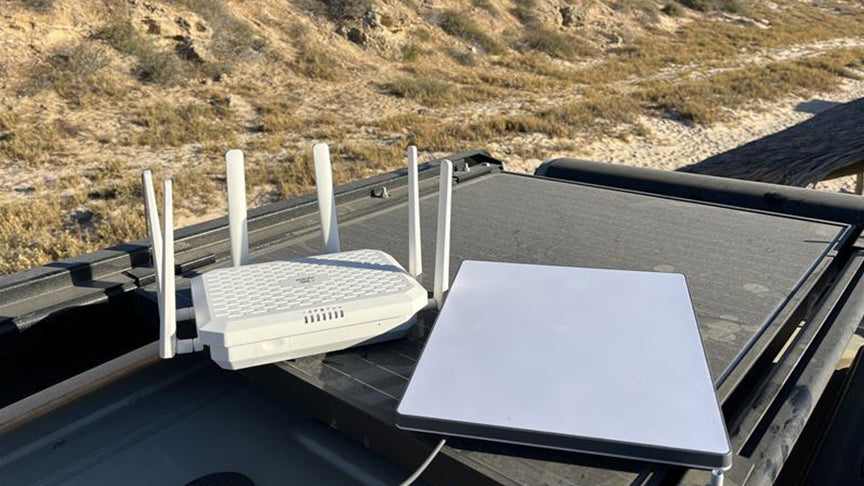
When the cellular vs satellite RV internet conversation comes up, Starlink is usually the satellite half of it. "Starlink has been a game-changer for [RVers] as it provides actual broadband speeds in areas with no cell service," Colker says. Simply connect the device to power and position your dish, and voila, you're online. Starlink's coverage includes almost anywhere with a clear line of sky in North America, Australia, almost all of South America, and some of Africa and Asia.
Starlink's unlimited Roam plan for RVs, nomads, and campers is $165 per month, which includes countrywide and international coverage, coastal coverage, and in-motion use. While the plan lines up to market standards, the upfront cost of the equipment can be a problem for RVers sticking to a budget. The Standard Kit is $349, the Mini Kit is $249 (with a $199 promotional price for new customers), and the Performance Kit is $1,999.
Other Satellite Options
According to Colker, DISH offers satellite internet to RVers, but "their service has been slower and less dependable than Starlink." He adds that setup and installation is more complicated, and for RVers needing flexibility and solid internet speeds, "Starlink is the more desirable satellite option."
Beyond DISH, other satellite providers like Hughesnet and Viasat exist, though most are built for residential use rather than the in-motion or stop-to-stop needs of RV life. Project Kuiper, Amazon's competing LEO satellite service, is also rolling out and worth keeping an eye on if you want satellite competition that could drop prices.

Choosing the Right Unlimited Internet for Your RV Use Case
The right plan depends less on specs and more on what you're actually doing online.
Remote Work and Productivity
If you’re working from your rig, you need low lag time, consistent online time, and the ability to support Zoom calls and Cloud transfers without the internet freezing on you. TravlFi or Verizon are strong picks here for reliability. If you boondock often or work from places with no cell coverage, layering Starlink on top gives you backup for when cellular drops. The dual setup costs more, but you're rarely caught offline mid-meeting.
Streaming & Media Consumption
For those who stream, play video games often, or partake in other activities that use a lot of data, TravlFi is a great option because of its high data threshold. Its multi-carrier coverage also means you'll stay connected pretty much anywhere in the U.S., plus Canada and Mexico at no extra charge. T-Mobile AWAY's flat-rate unlimited works well in coverage zones but can deprioritize during high-traffic hours, while Starlink handles streaming fine in remote spots where cellular can't reach.
Off-Grid Travel & Rural Coverage
If you travel internationally or in remote areas with minimal sky obstructions, Starlink can provide internet connection even if no cell service is available. To decide if Verizon, T-Mobile, or AT&T is best for cellular-dependent off-grid travel, it's a good idea to look at coverage maps online and choose accordingly. For example, T-Mobile has quite a few gaps in coverage in the Mountain West region of the U.S., though those areas are newly supplemented by T-Satellite. Verizon's rural coverage gives it an edge over T-Mobile and AT&T for cellular-only setups.
Cost-Conscious Travelers
For weekend campers and part-time RVers who don't need data every month, TravlFi's pay-as-you-go pricing is the most flexible because you can pause or downgrade during stretches when your rig is parked. Verizon bundle pricing can also work well if you're already using their phone service. Skip Starlink if budget is tight though, since the upfront hardware cost (and the higher monthly fee) makes it the priciest option overall.
Compare Unlimited RV Internet Plans
|
Provider |
Monthly Fee |
Equipment |
Data Rules |
Typical Speeds |
Best For |
|
TravlFi |
$19-$129/mo |
$159+ for hotspot or router |
May be throttled to 5 Mbps after 800GB |
25-300+ Mbps |
Multi-carrier coverage and high data users |
|
T-Mobile AWAY |
$110/mo (200GB) or $160/mo (Unlimited) |
5G Gateway included |
Deprioritization during congestion |
Up to 245 Mbps in 5G zones |
Suburban and urban-area RVers |
|
Verizon |
$20–$80/mo (when bundled) |
Router required |
No throttling on most unlimited plans |
Varies by region |
Rural and nationwide cellular coverage |
|
AT&T |
Varies by hotspot plan |
Hotspot device required |
Standard fair use policies |
Varies by region |
Highway-adjacent and urban travel |
|
Starlink Roam |
$55/mo (100GB) or $175/mo (Unlimited) |
$249 (Mini) to $1,999 (Performance) |
Soft cap; deprioritization in dense zones |
25-220 Mbps |
Off-grid and remote boondocking |
FAQs About Unlimited RV Internet
What is the best unlimited internet for RVs?
The best unlimited RV internet depends on your data needs and where you travel. With TravlFi, you have the option of stationary routers or a portable hotspot so you can be covered wherever you go. TravlFi's unlimited plans are on a cancel-anytime, pay-as-you-go basis, making it a great option for those who may not constantly need unlimited internet. According to Colker, Starlink is also a great option because of its vast coverage, but the pricey devices may deter some customers.
Can I get truly unlimited internet for my RV?
TravlFi's unlimited internet plans are very close to being truly unlimited; TravlFi has an extremely high data threshold compared to most other carriers, meaning you will not experience any deprioritization or throttling until you've reached 800GB of data use (hundreds more of data than many other carriers offer) and speeds would only be reduced to a minimum of 5 Mbps.
Which carrier has the best RV internet plans?
The best carrier for you depends on where you travel the most. Colker points out that rural or remote area travelers may find Verizon to be the most reliable because of its strong nationwide coverage. For travelers in more suburban and urban areas, however, T-Mobile's AWAY plan can offer excellent 5G speeds.
Is Starlink better than cellular internet for RVs?
"Starlink is better when it comes to providing high-speed internet to the boondocks where no cellular carrier can reach. It's especially useful for boondockers who need reliable service to work or stream," says Colker. "That being said, cellular internet may be more convenient when driving through areas that are populated, as you don't have to set up equipment with each stop. Many RVers use Starlink as their primary service and keep a cellular plan as a backup, so they're always covered no matter where they are," he continues.
How much does unlimited RV internet cost?
The cost of your unlimited RV internet depends on your plan, but it doesn't have to break the bank. TravlFi offers unlimited plans at $129 a month, but with no contracts, you never pay for more than you need. Additionally, TravlFi's internet devices and equipment come at affordable price points compared to other options.
More Essential Reading for RVers
Which TravlFi Device Is Right for You?
TravlFi keeps you connected on the road. Not sure which device is best for you? Compare below.

Ready to travel without limits? Learn more about how TravlFi can help.




Share: