


A side-by-side look at satellite vs cellular internet for RV travel — coverage, costs, setup, and which one fits your travel style.

In This Article
-
The cellular vs satellite RV internet basics
-
What TravlFi is and how it works
-
How satellite internet works on the road
-
Side-by-side comparison of coverage, speed, equipment, cost, and setup
-
Pros and cons of satellite internet for RV and cellular internet for RV
-
When each option is better for your travel style
-
Why many full-time RVers run both setups
-
FAQs
A stable internet connection has gone from luxury to necessity for travelers, RV owners, and remote workers who depend on staying connected. Whether you're working from a campsite or streaming Netflix on the road, having a dependable internet source matters. Two options for internet on the go are TravlFi and satellite internet, like Starlink, and the TravlFi vs Starlink debate keeps coming up in vanlife forums and full-time RV groups.
We look at plans, data caps, connectivity methods, product cost, and installation requirements to compare both options and help you decide which service is the best fit for your travels. According to the RV Industry Association, 22% of RV owners now have someone in the household working remotely, and over half of them work from the RV, so picking the right RV internet setup matters more than it used to.
TL;DR
For most RV travelers, TravlFi (cellular) wins on price and ease of setup, while satellite internet like Starlink wins for boondocking in remote locations. Cellular works for most campgrounds and travel corridors with just a hotspot, but satellite reaches the spots cell towers can't. Many full-timers use both, with TravlFi as their main connection and satellite as backup for when cellular isn’t reachable.
Experts Who Contributed to This Guide
-
This article was reviewed by Amanda Capritto, full-time vanlifer and TravlSync editor.
-
This article was written by Lauren Keary, experienced travel journalist.

Cellular Vs Satellite: At a Glance
When RVers talk about getting online, they’re usually talking either cellular internet (like TravlFi's hotspots and routers) or satellite internet (like Starlink). Each draws signal from a different source, and that one difference affects everything else, including coverage, cost, setup, and how usable the connection is on the road.
-
TravlFi: A cellular-based pay-as-you-go internet service designed for travelers. Uses cell towers for coverage across North America. Connectivity is dependent on proximity to cell towers and works best in areas with strong 4G/5G signals. Works for most regions with cell service, but not in very remote areas.
-
Satellite internet: A satellite-based system that doesn't rely on ground-based infrastructure. Provides coverage by connecting to low-Earth orbit satellites and works in rural and remote areas where traditional cellular or wired internet options are unavailable. Requires a clear line to the sky for reliable performance.
For most RVers, cellular is the default. The gear is affordable, the hotspots are portable, the setup is easy, and it works anywhere you have a decent cell signal (which covers most campgrounds and travel routes across the country). Satellite gets more popular the further you are from cell towers. Boondockers and remote workers parked beyond LTE range use satellite as a way to stay online.
Satellite internet is becoming more popular with RVers because it can keep you connected when you lose cell coverage, but equipment and setup costs are higher, and it has its own issues (more on those below). As with most RV-adjacent purchases, it’s going to come down to your travel style and how often you travel off-grid.
What Is TravlFi?
TravlFi is a cellular-based, pay-as-you-go internet service made for RVers and worker bees who need to have a connection on the road. Instead of locking you into a contract, TravlFi devices pull signal from multiple major U.S. networks automatically, so you're always grabbing whichever carrier has the strongest signal in your area. The product lineup includes portable hotspots and a stationary router, all paired with pay-as-you-go data plans that let you scale up or down based on how much you're traveling that month.
How TravlFi Works for RV Travel
The basic idea behind TravlFi is a small device that pulls signal from cell towers and converts it into Wi-Fi for all your devices (similar to how your phone works). The difference is that TravlFi hotspots and routers aren't tied to a single carrier.
Hotspots and routers connect to 4G LTE and 5G networks through nearby cell towers. As you drive, the device automatically finds the strongest signal available at your location. Connectivity is dependent on proximity to cellular networks and works best where there are strong 4G/5G signals, which means it may struggle in more remote areas.
Most phones lock you into one carrier, and if that carrier has weak coverage where you're parked, you're just going to have to be offline. TravlFi devices use TowerSync to search across multiple major U.S. networks, so when one carrier drops, the device picks up signal from another. For RVers zooming around different regions, that usually means fewer dead zones and steadier connections.
Pay-As-You-Go Data Model
TravlFi runs on a pay-as-you-go model with no annual contracts. Users can purchase the TravlFi device and pay monthly for the data they need, whether that's a few gigabytes for weekend trips or an unlimited plan for full-time work-from-anywhere life. If you're parked in one spot for a few weeks, you can pause or downgrade. If you hit the road for a month-long trip, you can add more data. That flexibility is a real benefit for seasonal travelers who don't want to pay for data they're not using when they aren’t traveling.
How Satellite Internet Works for RV Travel
Satellite internet communicates directly with satellites in low-Earth orbit (LEO), which send internet signal back down to your dish. Because it's a satellite-based system that doesn't rely on cell towers, it works in rural and remote areas where traditional internet options are unavailable.
Low-Earth-Orbit Satellites: RV satellite services like Starlink rely on a constellation of small satellites orbiting roughly 340 miles above Earth, which is much closer than the older geostationary satellites that powered earlier satellite internet. The closer orbit means less lag time and faster speeds, which is what made LEO satellite usable for things like video calls and streaming. Other LEO services like Project Kuiper are rolling out, too, meaning Starlink isn't the only satellite game in town anymore.
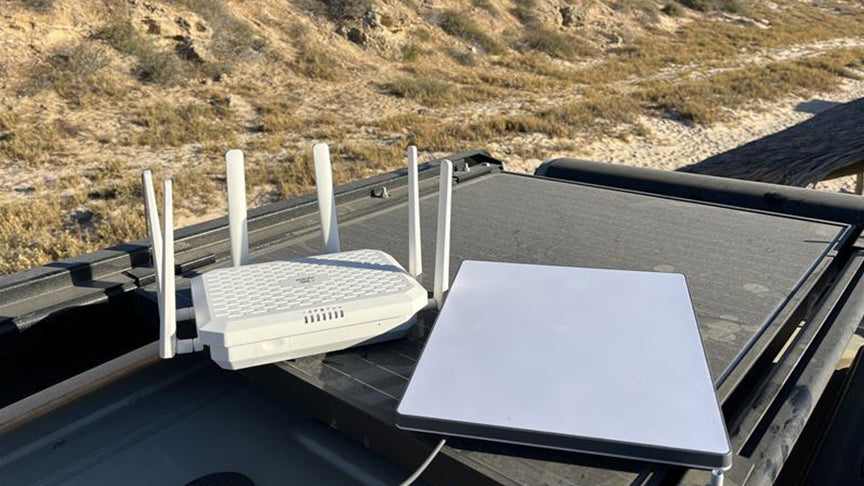
Satellite Dish and Router Equipment: Most satellite internet setups include a dish and an indoor router. The dish has to physically point toward the sky and connect with the satellite constellation overhead. Some kits are designed for stationary use, while others (like Starlink Roam) are built for mobile setups, with a dish that can be repositioned every time you change locations.
Coverage in Remote Areas: Satellite works where cell towers don't. National forests, deep desert campsites, mountain valleys, and other places far from cell towers are the spots where satellite takes the win. If your travel often lands you 20+ miles from a town, satellite is often the only way to get a usable connection.
Requirements for Clear Sky Visibility: Satellite requires a clear line of sight to the sky for best performance. Tall trees, rock walls, dense canopy, and severe weather can all interrupt or weaken the signal. Some campsites (especially the heavily wooded ones) are practically unusable for satellite because of the tree obstruction. Cloud cover and rain can also slow speeds, even with that clear line to the sky.

TravlFi vs Satellite Internet: Key Differences
Coverage and speed are where things get different in action, but equipment and setup differences are the ones you’ll feel right away.
Coverage
Cellular internet (TravlFi) works wherever you have decent cell signal, meaning most of the U.S. when you're on major roads, in towns, or at established campgrounds. The SOS zones are usually in national forests, mountain regions, isolated public land, and other places far, far away from any town.
Satellite internet can cover you in these remote locations so long as your equipment has a clear line to the sky. But a satellite dish in a forest may be spotty even when you’re technically covered in that area.
Speed and Latency
Cellular networks offer less lag, which matters most for video and gaming. 4G and 5G TravlFi devices typically have download speeds from 25 to 200+ Mbps, depending on your location and the device (the JourneyGo 5G goes up to 180 Mbps, for example).
Satellite internet, including Starlink, has similar download speeds with Starlink at 25-220 Mbps for residential and Roam plans. But the lag time for things like conference calls and gaming is higher than cellular, though most users won't notice the difference for just streaming or browsing.
Equipment and Setup
TravlFi’s devices don’t need installation. The JourneyGo 5G hotspot is about the size of a phone and runs on a battery; the XTR Pro 5G Router is stationary but plugs into AC power inside your rig. Truly all you need to do is power it on, and you’re good to get online. I’m not tech-savvy at all, and it only took me a few minutes to get online my first time using my JourneyGo 5G.
Satellite kits (like Starlink) do need installation and do require you to set up the satellite dish, which can eat up some of your time enjoying your new destination. The kit ships with a dish, mount, router, and cabling, and you have to put all that together yourself to make it work. That means finding a spot for the dish with a clear shot to the sky, and running the cables. Though stationary satellite is best, you can find portable versions, but they will still need an adjustment period in each new location.
Monthly Costs
TravlFi costs less upfront than satellite does. You can purchase a TravlFi device (one-time cost) and pay monthly for the data. Plans start around $19/month and go up to unlimited, no annual contract required.
Satellite internet, like Starlink, is a bigger investment for the kit (including the satellite dish), plus a monthly service fee on top of that cost. Starlink Roam plans for RVers are $55/month for the Roam 100GB plan and $175/month for unlimited Roam. Hardware costs $249 for the Starlink Mini and $349 for the standard dish, while TravlFi hotspots start at $159.
For full-time RVers who gobble up data, the difference in cost is probably small. But for weekend travelers or part-time RVers, cellular often costs much less than satellite—and truthfully, as a weekender myself, my husband and I have never needed more than our handy little hotspot.
Mobility and Ease of Use
TravlFi devices are portable and easy to set up anywhere, just toss them in your rig and turn them on when you arrive wherever you’re going. I grabbed my JourneyGo 5G on the way out the door for our most recent camping trip (yes, almost forgot it in the stress of packing), pulled it out when we got to camp, turned it on, and my husband and I were both online before we had even finished setting up camp.
Either way you look at satellite, though, you’re losing online time at each new camp with the setup requirements. Mobile satellite dishes like Starlink Roam are better for RV use than stationary ones, though you’ll always need to be able to set up with a clear line to the sky, no exceptions. Portable versions of satellite internet do exist, but even those will likely still take time to adjust in each new spot.
TravlFi vs Satellite Internet Comparison
|
Feature |
TravlFi (Cellular) |
Satellite Internet |
|
Coverage |
Strong in populated areas |
Works in remote regions |
|
Setup |
Plug-and-play hotspot |
Requires satellite dish |
|
Equipment cost |
From $159 |
From $249 (Mini) to $349 (Standard) |
|
Monthly cost |
From $19/month |
$55/month (Roam 100GB) to $175/month (Unlimited) |
|
Mobility |
Very portable |
Bulkier equipment |
|
Latency |
Lower |
Higher |
|
Best use case |
Travel corridors and RV parks |
Remote boondocking |
Pros and Cons of Cellular RV Internet
Pros
-
Affordable, starting at $159 for a hotspot
-
Flexible pay-as-you-go model
-
No installation or alignment required
-
Works well where there are solid cell networks, including most U.S. travel routes and campgrounds
-
Lightweight, portable devices
Cons
-
Works solely with cellular coverage, so signal drops off in truly remote areas
-
Slower speeds in high-traffic locations, especially during peak campground hours
-
Heavy streaming and Cloud transfers can gobble data fast
-
Carrier coverage (even multi-network) still has gaps
Pros and Cons of Satellite RV Internet
Pros
-
Global coverage, particularly great in remote areas
-
High-speed internet in rural locations
-
Less reliance on local network traffic at campgrounds
-
Good backup when cellular doesn’t exist
Cons
-
Longer setup that takes time at each new site
-
Costly at $249-$349 for hardware, plus $55-$175/month for service
-
Chance of issues in bad weather or obstructed locations
-
Latency is higher than it is with cellular, which can affect video
-
Bulkier build

When TravlFi Is the Better Choice for RV Internet
TravlFi (or cellular) wins for most RVers, especially if you typically travel to RV parks or campgrounds in a populated location, but more specifically:
-
RV parks and campgrounds, where cell coverage is usually solid and campground Wi-Fi doesn’t get the job done
-
Road trips through populated regions, where you travel throughout many states and need a connection that works in any of them
-
Travelers who want simple setup and aren't interested in dish alignment or troubleshooting line-of-sight issues
-
Budget-conscious RVers who don't want to drop $249+ on satellite hardware before they've even bought their first month of service
When Satellite Internet Is the Better Choice
The need for satellite gets stronger the further you go off-grid where cellular doesn’t exist, and satellite is truly the only way to remain online, like:
-
Remote boondocking on public land where the nearest cell tower is miles away
-
Off-grid exploration in national forests and wilderness areas without traditional connectivity
-
Locations without cellular infrastructure, like the Mountain West, deep desert, certain coastal areas, and remote spots of the Pacific Northwest
-
Backcountry adventurers who need to stay reachable for work or emergencies outside cell coverage
Why Many Full-Time RVers Use Both
Many full-time RVers find that TravlFi and satellite can work together. TravlFi handles the 80% of travel you do in or near populated areas, where cell signal is readily available. Satellite covers the 20% of travel that brings you deep into the backcountry.
Most full-timers who have both setups use satellite as an emergency tool rather than their everyday connection. Cellular is still their main internet source because it's cheaper and easier to set up. Satellite stays packed up most of the time and only comes out when cellular isn’t working great.
The hybrid approach means you're paying for two separate services and two sets of hardware though, so it can get pricey. But for full-time RVers (particularly workers), the redundancy is worth the additional cash.
How to Choose the Right RV Internet Setup
Weekenders and snowbirds who stick to RV parks and developed campgrounds will rarely need anything beyond cellular. Full-timers who love remote spots are the ones who benefit from adding satellite on top of their cell setup. If you're often 20+ miles from a town, satellite starts paying for itself. But if most of your trips include a hookup site at an RV park, cellular is good on its own.
Browsing, streaming, emails, and basic remote work run fine on either. But if you desperately need uninterrupted Zoom calls or are sending tons of large files over email, you'll want to look closer at your routes and think about adding satellite to fill in when cellular fails. Cellular is cheaper across the board, but for RVers who need it, satellite covers a lot of spots cellular simply can’t.
FAQ: Cellular vs Satellite Internet for RV Travel
Is satellite internet better than cellular for RV travel?
Cellular costs less and works fine in the populated areas where most RVers travel. Satellite is better when your travel takes you truly off-grid. But when we’re talking about typical RV travel, cellular very much so wins out.
Do RVers really need Starlink?
For RVers who mostly stay at campgrounds, in RV parks, on established travel routes, and in other places with cell service, Starlink's $249+ hardware cost and $55-$175 monthly fee are frankly, not necessary. For boondockers and workers who camp far from towns or in straight-up wilderness, Starlink is likely the only way to stay connected.
Is cellular internet reliable enough for remote work?
Modern 4G LTE and 5G cellular networks handle Zoom calls, file transfers, video conferences, and remote work just fine when you're near populated areas. Multi-carrier devices like TravlFi's hotspots and routers help cover gaps by switching to whichever carrier has the strongest signal. The exception is when you camp far from cell towers, that’s when satellite takes over.
What is the cheapest RV internet option?
Cellular. TravlFi hotspots start at $159 with data plans from $19/month, while Starlink hardware costs $249 and up with monthly plans starting at $55. For weekenders and part-timers, the cellular total ends up far below satellite. The only time cellular costs more is when your travel keeps you in places without signal, at which point the cheap option doesn't work, and the math changes.
Should RVers have both cellular and satellite internet?
Running cellular as your main connection with satellite as backup covers everything from RV parks and busy campgrounds to remote boondocking miles from the nearest tower. The setup costs more initially and adds a second monthly bill, but you're rarely booted offline. If you’re full-time working on the road, this layered internet is where it’s at, but for weekend campers and light travelers, one or the other will be just fine.
More Essential Reading for RVers
-
4G vs 5G for RVers: What's the Difference and Which One Do You Need?
-
RV Must-Have Accessories: Best Camper Accessory Ideas to Make RV Life Easier
Which TravlFi Device Is Right for You?
TravlFi keeps you connected on the road. Not sure which device is best for you? Compare below.

Ready to explore how TravlFi can enhance your connectivity on the go? Check out our plans today and experience the freedom of reliable internet wherever you are.




Share: