

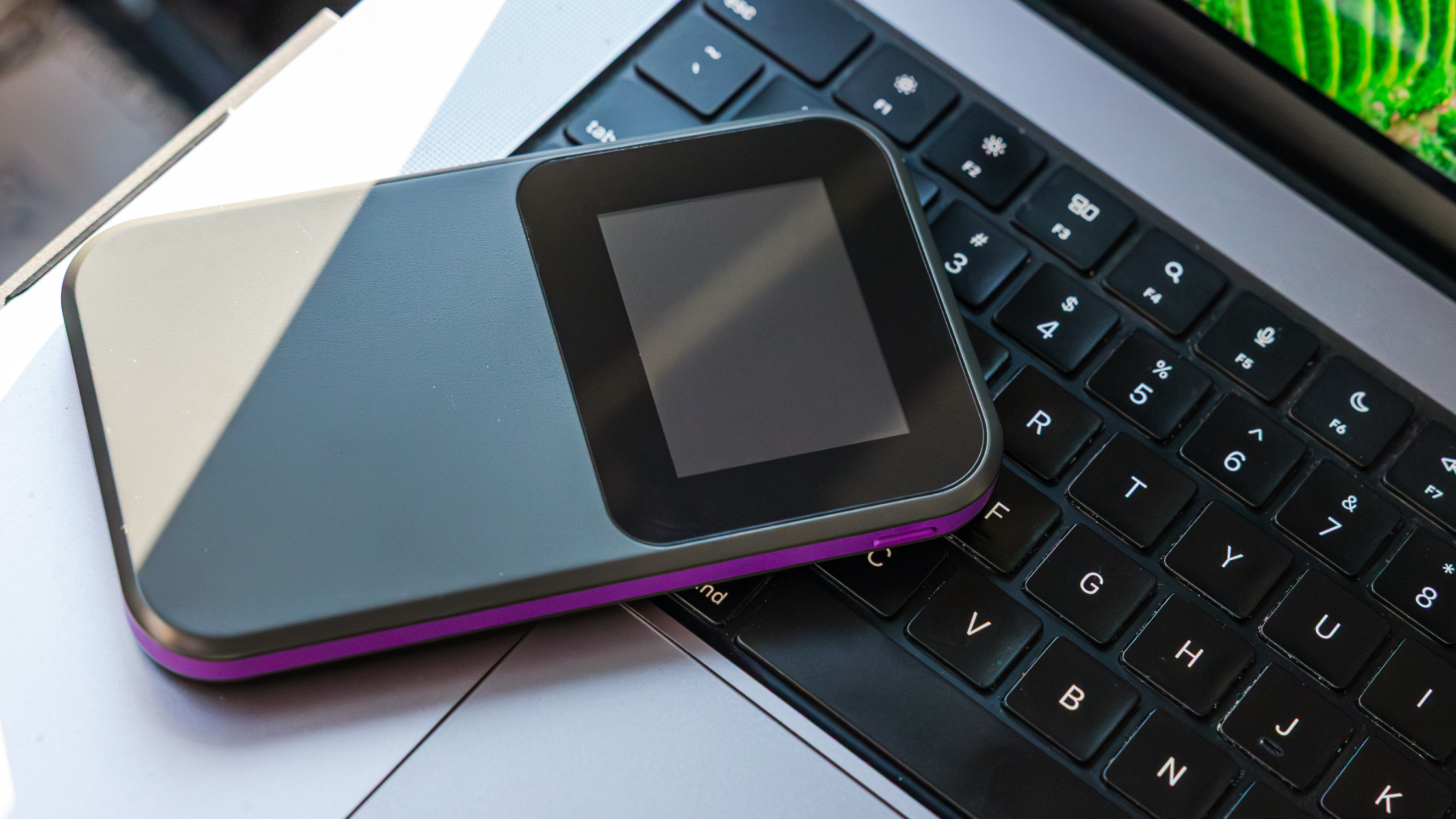
TravlFi just upgraded its portable hotspot with with 5G capabilities, a bigger battery, more device connections, and a touchscreen.

In This Article
-
What the TravlFi JourneyGo 5G is and who it's built for
-
Full feature breakdown: touchscreen, battery, connectivity, water resistance, and more
-
Real-world speed and capabilities
-
Comparing this device to TravlFi's other devices
-
Where to buy and current pricing
-
FAQs
TravlFi just raised the bar for portable RV internet. The new TravlFi JourneyGo 5G hotspot ($299) is a smartphone-sized, 5G-enabled cellular hotspot built for RVers, vanlifers, and travelers who need fast, reliable internet on-the-go—without being tied to a router or a power outlet. It connects up to 16 devices over a 75-100 foot range, lasts up to 24 hours on one charge, and runs on TravlFi's pay-as-you-go data plans. It's available starting April 6, 2026.
If you've already used TravlFi's JourneyGo 4G LTE hotspot ($199) and want to take your Wi-Fi game up a notch, this new 5G hotspot makes for a great upgrade. The JourneyGo 5G boasts faster speeds (25-150 Mbps), a 2.4-inch touchscreen interface, dual-band Wi-Fi 6, and weather resistance in a smartphone-sized device that you can toss in your bag or even shove in your pocket. As TravlFi connectivity specialist Jeff Gwinnell raves: "The same TravlFi pay-as-you-go multi-network service, now with 5G speeds." Whether you're working from a campsite, streaming from a rest stop, or keeping the kids connected on a cross-country road trip, this device complements life on the road seamlessly.
Experts Who Contributed to This Guide
-
Jeff Gwinnell, a connectivity specialist at TravlFi, contributed expertise to this article.
-
This article was written by Lauren Keary, an experienced travel writer.
What Is the TravlFi JourneyGo 5G?

The TravlFi JourneyGo 5G is a standalone 5G cellular hotspot—a small, battery-powered device that creates its own private Wi-Fi network using cellular data. It’s basically a personal internet hub you can take anywhere. It's about the size of a smartphone, lightweight enough to toss in a bag or clip to your dashboard, and doesn't require any installation or hard-wiring. It's also TravlFi's second-ever 5G product, following the XTR Pro 5G router—but in a completely different form.
The JourneyGo 5G and XTR Pro 5G aren't really in the same product class. The XTR Pro is a full-size router designed for permanent RV installation. The JourneyGo 5G is a pocket hotspot. But the fact that TravlFi's 5G technology now comes in a portable package is a big deal for travelers who want 5G speeds without a more permanent router setup.
It's the portable option in TravlFi's lineup. Where TravlFi's routers (like the JourneyXTR and XTR Pro 5G) plug into AC power and are designed for semi-permanent RV setups, the JourneyGo 5G runs on a 5,000 milliamp-hour (mAh) battery and can travel with you outside your RV. At just 165 grams (about the same as an apple) and roughly the size of an iPhone, it's easy to toss in a bag, clip to your dashboard, or slip into a pocket. Take it hiking, bring it to the beach, use it at the campsite during the day, and charge it overnight via USB-C 3.0.
The device ships ready to activate—no SIM card to hunt down or install. Just push power, follow the 2.4-inch touchscreen prompts, and you're connected. In the box, you'll find the hotspot itself, a USB-C charging cable, and a quick start guide.
TravlFi JourneyGo 5G Features
"Compared to the original JourneyGo, the JourneyGo 5G features an all-new pocket-friendly design, easy-to-use touchscreen, and now connects up to 16 personal devices to TravlFi's 5G multi-network pay-as-you-go service," TravlFi’s connectivity specialist Jeff Gwinnell says. But here's more on what's under the hood.

Touchscreen Control
The JourneyGo 5G has a 2.4-inch color TFT touchscreen display, which is a first for TravlFi's hotspot lineup. You can check your signal strength, view connected devices, monitor data, change settings, and even manually initiate a TowerSync® network scan right from the screen. No app or web browser needed. It's easy to use, and it means you can manage your connection at a glance while you're out in the field.
Battery Life
This is one of the biggest upgrades over the previous JourneyGo 4G LTE. The JourneyGo 5G packs a 5,000mAh battery rated for up to 24 hours on one charge. This battery life is a significant jump from the 4G model's 4,700mAh/16-hour battery. You’ll get a full day of connectivity without needing to plug in, but when it does need juice, it charges via USB-C 3.0 (5V/2A input).
Real-world battery life will vary depending on the number of devices you connect, what you're doing (streaming uses more power than checking email), and whether you're on 5G or falling back to 4G LTE. But even under heavier usage, all-day battery life is realistic for most travelers.
But unlike the JourneyGo 4G, the 5G model does not double as a power bank. The older model could charge other USB devices in a pinch (5V/1A output)—the JourneyGo 5G drops that feature to preserve its own battery longevity.
Connectivity
The JourneyGo 5G connects to 5G networks with automatic fallback to 4G LTE when 5G isn't available. That dual-mode approach means you won't lose your connection if you drive out of a 5G zone.
It also supports dual-band Wi-Fi 6 (802.11ax on both 2.4GHz and 5GHz), which is the latest standard for wireless connections between the hotspot and your devices. Wi-Fi 6 handles more simultaneous connections, delivers faster speeds over short distances, and is better at managing congestion when a number of devices are pulling data at the same time. The 5GHz band is your best bet for speed-intensive tasks like Zoom calls and streaming, while 2.4GHz gives you better range for devices farther from the hotspot.
For context, the JourneyGo 4G only ran on 2.4GHz Wi-Fi 4—so this is a huge jump in wireless performance between the hotspot and your devices.
Dual eSIM and Physical Nano SIM
The JourneyGo 5G ships with a built-in eSIM—which means no card to install and no activation hoops to jump through. Push power, go through the prompts, and you're connected. But it also includes a physical Nano SIM slot, which gives you the option to pop in a local carrier's SIM when traveling internationally or if you want to run a secondary data plan. It's a flexibility play that TravlFi's 4G hotspot didn't offer.
Carrier Compatibility
TravlFi devices use multi-network technology—what TravlFi calls TowerSync—that scans for and connects to the strongest available cellular signal regardless of carrier.
This is a meaningful advantage for RVers, since coverage varies wildly depending on where you're parked. Multi-network connectivity is one of the key reasons travelers choose TravlFi over carrier-locked hotspots.
Pay-As-You-Go Data Plans
Like all TravlFi devices, the JourneyGo 5G runs on flexible, no-contract data plans. You pay for the data you use, and you can shift your plan when your travel schedule changes. No annual commitments or cancellation fees.
This makes it especially practical for seasonal travelers or weekend campers who don't need data year-round. Buy a plan when you hit the road, pause when you're home.
Learn more about TravlFi’s data plans.
Multi-Device Support
The JourneyGo 5G supports up to 16 device connections at a time over a 75-100 foot range—an increase from the 10 devices and 50-75 feet range on the JourneyGo 4G. Doing the math, that should cover a laptop, a tablet, a couple of phones, a smart TV, and a handful of IoT devices (cameras, sensors, etc.) without maxing out connections—and the range is wide enough for the majority of campsites.
For solo RVers and couples, 16 connections is likely plenty. Even for families with kids who all have their own devices, everyone can be online at the same time without needing to rotate who gets Wi-Fi (pending family size, of course).
Water Resistance
The JourneyGo 5G has an IP54 rating, which means it's protected against dust getting in the device and light splashes from water on all sides. Let’s be clear: it’s not a device you should be bringing on your afternoon lake swims, but rain, morning mist, and the general wear-and-tear of traveling outdoors shouldn’t be an issue. Additionally, it has 80cm drop resistance, so short tumbles on hikes or off picnic tables won’t kill your connection (so long as those tumbles aren’t into a body of water).
RVers and campers don't always have the luxury of keeping their gear dry—or keeping it from falling off things—so this is a great addition for our travel friends who spend a good majority of their life outdoors.
TravlFi JourneyGo 5G Performance

With 5G and Wi-Fi 6, the JourneyGo 5G is built to deliver faster speeds than its 4G predecessor, particularly if you’re parking or camping within a 5G coverage area.
For 5G, expect typical download speeds of 25-150 Mbps (180 Mbps peak). On 4G LTE backup, you're looking at 15-40 Mbps (75 Mbps peak). For reference, the JourneyGo 4G topped out at 15-30 Mbps typical (60 Mbps peak). The JourneyGo 5G supports 5G NSA with theoretical maximums of 2.77 Gbps down and 1.25 Gbps up. Now these aren’t numbers you’re going to actually come close to in real life, but they show the hardware isn't the issue.
For most RVers, the real performance question is consistency. The JourneyGo 5G packs seven internal 5G and 4G LTE antennas (compared to two internal antennas on the JourneyGo 4G), and TowerSync technology continuously scans for the strongest available signal across networks and switches networks automatically. But the JourneyGo 5G uses internal antennas only—there's no external antenna port like you'd find with the JourneyXTR or XTR Pro routers. That's the trade-off for portability, but seven internal antennas is a big step up from what most smartphone-sized hotspots offer.
Though 5G coverage has been expanding across the U.S., it’s still most reliable around urban and suburban areas. In rural and remote locations, the device will fall back to 4G LTE—which is still functional for most needs (video and streaming included). But as 5G coverage reaches more campgrounds and highways, your device is already ready for it.
TravlFi JourneyGo 5G Hotspot vs. Other TravlFi Devices
TravlFi's lineup now includes four devices. Here's how the JourneyGo 5G fits in.
JourneyGo 4G LTE Hotspot
The JourneyGo 4G ($199) is the device the JourneyGo 5G is replacing as TravlFi's flagship portable hotspot. This prior model connects up to 10 devices, has a 16-hour battery, and runs on 4G LTE only. It's a capable device for light use—weekend camping trips, checking email, light browsing—but the JourneyGo 5G outpaces it. More devices (16 vs. 10), longer battery (24 hours vs. 16), faster network (5G vs. 4G), and a touchscreen display the original doesn't have.
If you're deciding between the two, the 5G model is the clear upgrade unless you're on a tight budget and don't need the extra speed or battery life.
JourneyXTR 4G LTE Router
The JourneyXTR ($299) is in a different category of devices from the hotspots—it's a 4G LTE router that you plug into your RV's AC power to handle up to 32 devices. It's made for folks who want a semi-permanent internet install and pairs with an external antenna for improved signal.
Snag the JourneyXTR over the JourneyGo 5G if you want an always-on connection inside your rig and don't necessarily need portability. But opt for the JourneyGo 5G if you want to be able to toss your internet in your backpack when you leave the RV.
JourneyXTR Pro 5G Router
The XTR Pro 5G ($549) is TravlFi's most powerful offering. This 5G router manages up to 200 total devices (128 over Wi-Fi) and boasts Wi-Fi 6 speeds with six external cellular antennas pulling in max signal. As such, it's built for travelers with max internet needs—families, full-time remote workers, gamers, and Netflix streamers who don’t mess around when it comes to staying connected. (TravlFi also has an XTR Pro V2 coming with Wi-Fi 7 and faster 5G specs but the original XTR Pro still currently sits in the top slot for now—stay tuned.)
The XTR Pro and JourneyGo 5G actually make a great combo. Use the XTR Pro as your home-base router inside the RV, and bring the JourneyGo 5G with you as a portable option when you step away from camp. Some full-timers even use both at the same time for redundancy.
Where to Buy the TravlFi JourneyGo 5G Hotspot

The TravlFi JourneyGo 5G hotspot retails for $299 and is available starting April 6, 2026 at TravlFi.com. You can also buy it from Amazon.
Price wise, that means it sits between the JourneyGo 4G ($199) and the XTR Pro 5G router ($549). It provides a solid upgrade in speed, battery, and capabilities from the 4G hotspot but won’t be as hard on your bank account as the full router setup.
FAQs
What carriers does TravlFi work with?
TravlFi isn't tied to a single carrier. Its TowerSync technology finds the strongest available signal between multiple major carriers. You don't need to pick a carrier or swap SIM cards either because the device does so automatically.
How does TravlFi work?
TravlFi devices connect to nearby cell towers to create a private Wi-Fi network for your personal devices. It’s the same process your phone implements to get internet when you’re away from Wi-Fi, but it’s delivered through a dedicated device with a stronger antenna and more connection capacity. Plug it in (or charge the battery for hotspots), power it on, and you’re good to start connecting. TravlFi's pay-as-you-go plans mean you only pay for the data you use.
Is TravlFi RV internet any good?
Yes, and we're not just saying that because this is the TravlFi blog. TravlFi devices consistently boast great reviews from full-time RVers and vanlifers because of multi-network coverage, data flexibility, and solid performance. Check out our piece on how a digital nomad family uses TravlFi on the road for a real life perspective, or read our TravlFi vs. Starlink comparison for a look at how it stacks up against satellite internet.
More Essential Reading for RV Owners:
Which TravlFi Device Is Right for You?
TravlFi keeps you connected on the road. Not sure which device is best for you? Compare below.

Ready to find your connection? Learn more about TravlFi devices and pay-as-you-go data plans.





Share:
TravlFi Introduces the JourneyGo 5G: A Portable Hotspot Built for Life on the Road
What Is eSIM Technology? How Embedded SIMs Work for RV Internet