

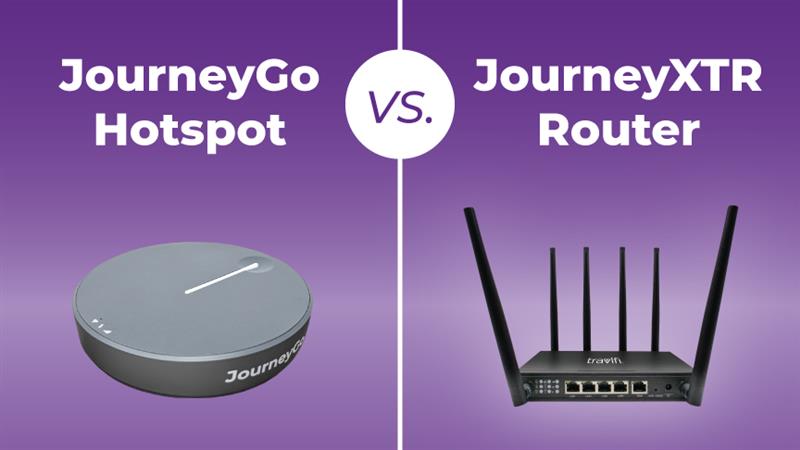
Do you need a router? A hotspot? Both? Find out which device is right for you based on your needs.
In This Article
-
What's similar between the JourneyGo and JourneyXTR
-
What's different
-
Who the JourneyGo is for
-
Who the JourneyXTR is for
-
Using both devices together
-
FAQs
Life on the road is all about exploring, which means you won’t always have a stable internet connection. An RV Wi-Fi router or hotspot can help with that, but how do you know which is right for you? TravlFi has both options to compare: the JourneyGo hotspot vs. JourneyXTR router.
Both provide a secure Wi-Fi connection, but they have different features that support different types of internet users. Understanding their differences is key to making your connectivity on the road that much more reliable and convenient.
TL;DR
The TravlFi JourneyGo is a portable 4G LTE hotspot that supports up to 10 devices and runs on battery—ideal for weekend campers and on-the-go use. The JourneyXTR is a semi-permanent router that supports 32 devices with faster speeds and more advanced security features, making it a better fit for full-timers, remote workers, and families. Both use eSIM technology with TravlFi’s pay-as-you-go data plans.
Experts Who Contributed to This Guide
-
Jeff Gwinnell, a connectivity specialist at TravlFi, contributed expertise to this article and reviewed it for accuracy.
-
This article was written by Ever Vigee, an award-winning writer and digital advertising student at Louisiana State University.

TravlFi JourneyGo vs JourneyXTR: What’s Similar?
Multi-Network, 4G LTE Connection
Both the JourneyGo hotspot and the JourneyXTR router use 4G LTE connection and, with eSIM technology, are able to seamlessly switch to the strongest network in your area across multiple major networks.
Data Plans
TravlFi’s flexible pay-as-you-go data plans are identical between the two devices. Depending on your data needs, you can choose between from plans ranging from 2GB to unlimited.
TravlFi JourneyGo vs JourneyXTR: What’s Different?
Device Type and Power
The biggest difference between the two devices is their intended use: Routers and hotspots both provide an internet connection but work best in different situations.
First, let’s clarify the difference between a hotspot and a router. According to Gwinnell, “A hotspot is a small, battery powered portable cellular device with the sole purpose of connecting a handful of Wi-Fi-enabled devices to the internet.” They are easy to use and generally require little to no setup, he adds.
Cellular routers, on the other hand, are feature-rich devices that provide a secure Wi-Fi connection. They also provide complete network management and access security, says Gwinnell. The JourneyXTR also requires external power via AC/DC cord for a more semi-permanent installation.
Both devices, however, contain a cellular modem, cellular antennas, and eSIM to connect your devices to a major cellular network either via Wi-Fi or physical networking protocols.
Device Support
Because the JourneyGo is designed for compact convenience, it supports fewer devices than the JourneyXTR: the JourneyGo supports up to 10 devices while the JourneyXTR is capable of supporting 32 devices.
TravlFi JourneyGo Hotspot: Who It’s For
Travelers who seek a simple, easy-to-use Wi-Fi connection would benefit from the JourneyGo hotspot. A portable, private Wi-Fi connection is especially useful for those who are concerned with sketchy public Wi-Fi networks.
Online Needs
“With a good connection,” says Gwinnell, “the JourneyGo can support web browsing, music streaming, quality video streaming, email, and small file downloads.” If you engage in online activities that require more substantial data, like larger file downloads, gaming, or 4K streaming, the JourneyXTR would be more suitable for you.
Typical Users
The JourneyGo can be used in the RV by small families, but because it supports 10 devices, some travelers may exceed that limit, Gwinnell says. For families with more than 10 Wi-Fi enabled devices, the JourneyXTR would be more ideal.
Security Features
The JourneyGo keeps you safe by creating “its own private Wi-Fi network with WPA2 encryption and is secured with a unique, randomly generated Wi-Fi password.” Although the device cannot support VPN installation, software-based VPNs may still be an option.
TravlFi JourneyXTR Router: Who It’s For
The JourneyXTR is a semi-permanent device ideal for use inside of the RV, but it may be more suitable for certain online activities like quality streaming, gaming, or remote work.
Online Needs
Because of its more advanced hardware, the JourneyXTR is more ideal for travelers who may need the option for wired connectivity via Ethernet/LAN cable. This can include small printers or PCs. The JourneyXTR also has slightly faster speeds (compare its average 15-50 Mbps to the JourneyGo’s average 10-35 Mbps), but if you desire the fastest speeds possible, the JourneyXTR Pro router may work better for you.
Typical Users
According to Gwinnell, the JourneyXTR is typically used by one to two people or small families. The router has the capacity to support online browsing, light remote work, video conferencing, and fair quality video streaming. For those who play video games or engage in more demanding online activities, check out the JourneyXTR Pro router.
Security Features
While both devices provide you with a secure Wi-Fi connection, the more advanced hardware in the JourneyXTR provides some additional security features over the JourneyGo. The JourneyXTR has a built-in firewall with WPA3 wireless encryption protocol. Gwinnell notes that the device also has completely customizable Wi-Fi settings, port forwarding, custom DNS, domain filtering, and MAC address filtering. In addition to these built-in security features, the JourneyXTR is also capable of supporting PPTP and L2TPv2 or v3 VPN installation.
Optimize Your Travel
Although these two devices serve travelers differently, they can complement each other well. Since the JourneyXTR is ideal for stationary use within the RV, you can think of it more as your Wi-Fi hub where you may conduct more demanding online activities. On the other hand, think of your JourneyGo for trips away from the campsite, such as to a coffee shop.
FAQs
What is the best TravlFi hotspot?
TravlFi’s JourneyGo hotspot delivers Wi-Fi with 4G LTE connectivity. It fits in your pocket, and with a battery lasting up to 16 hours on one charge, the JourneyGo can go wherever you go all day. The JourneyGo supports up to 10 devices, so it’s a great option for solo travelers or small families who need portable internet on the go.
How can I improve my TravlFi connection?
If you are experiencing slow connection speeds, first make sure your device is set up properly. If you are still experiencing slow speeds, experiment with the placement of your device: Avoid physical obstructions like drawers or try moving your RV to more open areas. Some travelers benefit from extensions like signal boosters to amplify an existing cellular signal. There could be many other factors affecting internet speeds, so read our guide on how to get the best signal with your TravlFi device.
What carriers does TravlFi use?
According to Gwinnell, TravlFi devices have access to the largest carrier networks in the U.S. Depending on your location and which towers are nearby, you will be connected to the strongest one thanks to eSIM technology.
More Essential Reading for RVers Who Want to Stay Connected:
Which TravlFi Device Is Right for You?
TravlFi keeps you connected on the road. Not sure which device is best for you? Compare below or take our device quiz.
Interested in taking your journey to the next level with TravlFi? Learn more about how to get started.






Share: