

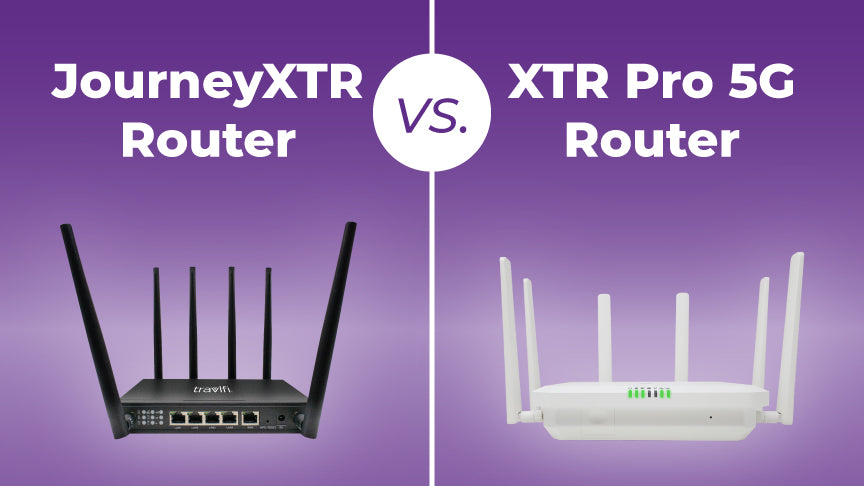
A TravlFi connectivity specialist breaks down the pros, cons, and best uses of our two popular mobile Wi-Fi routers.

In This Article
-
What the JourneyXTR and XTRPro have in common
-
Key differences between the two routers
-
Who the JourneyXTR is best for
-
Who the JourneyXTR Pro 5G is best for
-
FAQs about TravlFi hotspots and RV internet
Whether you work remotely, stream videos, or simply want to stay connected with loved ones, the router you choose can make or break your connection experience, and therefore, your travel experience. So, great! Now you know you need a good router…but wait, with thousands of routers on the market, it can be overwhelming to choose the “best” one.
When looking at the TravlFi JourneyXTR vs. JourneyXTR Pro, however, it’s hard to go wrong. There are some key differences between the two routers that can make your connection that much more seamless. Here is a look into which device is best suited for your type of travel.
TL;DR
The TravlFi JourneyXTR and JourneyXTR Pro are both solid mobile Wi-Fi routers, but they serve different needs. The JourneyXTR runs on 4G LTE, supports up to 32 devices, and offers flexible data plans—ideal for solo travelers, couples, or small families doing light browsing and streaming. The JourneyXTR Pro steps up to 5G (with 4G LTE backup), supports up to 128 devices, and delivers lower latency for gaming, streaming, and remote work.
Experts Who Contributed to This Guide
-
Jeff Gwinnell, a connectivity specialist at TravlFi, contributed expertise to this article and reviewed it for accuracy.
-
This article was written by Ever Vigee, an award-winning writer and digital advertising student at Louisiana State University.

TravlFi JourneyXTR vs. XTR Pro: What’s Similar?
Although the JourneyXTR and JourneyXTR Pro are suitable for different types of internet users, there are still several similarities between the two devices. Here’s what you can expect from both.
Device Setup
According to Jeff Gwinnell, a connectivity specialist at TravlFi, initial setup for the two devices is almost identical:
-
Attach the included antennas.
-
Plug in the AC/DC power cord.
-
Turn on the router.
-
Call TravlFi to activate the router.
-
Connect your devices to the router’s Wi-Fi or Ethernet/LAN cable (unique default passwords and connection information are on the bottom of each device).
eSIM Technology and Multi-Network Coverage
Both devices use eSIM, or embedded SIM, technology allowing you to connect to the strongest signal in your area across multiple major networks. Because your SIM is digitally embedded in your device, you do not have to worry about a physical SIM card during setup or device maintenance, making both devices more user-friendly.
Security Features
The JourneyXTR and JourneyXTR Pro both have a built-in firewall and support the latest WPA3 wireless encryption protocol. There are also port forwarding, custom DNS, domain filtering, and MAC address filtering. Gwinnell adds that the Wi-Fi settings are completely customizable, too.
TravlFi JourneyXTR vs. XTR Pro: What’s Different?
Connection Type and Speed
The biggest difference between the JourneyXTR and the JourneyXTR Pro is the type of connection. The JourneyXTR uses 4G LTE while the JourneyXTR Pro provides 5G connection with the ability to switch to 4G LTE for backup. According to Gwinnell, 5G is a newer generation of radio technology that allows for extremely quick transmission speeds as well as more data to transfer between the device and cell tower.
The type of connection is not the only factor affecting internet speeds, however. The JourneyXTR Pro requires much more substantial hardware compared to the JourneyXTR and has a more advanced operating system, processing power, and memory which all contribute to the higher speeds.
Learn more: What’s the Difference Between 4G and 5G?
Device Support
The differences between the devices’ hardware also impact the number of devices that can connect to the router at once. The JourneyXTR can support the connection of up to 32 devices while the JourneyXTR Pro is capable of supporting up to 128 devices simultaneously.
Data Plans
Both devices support pay-as-you-go data, but the JourneyXTR does have more options for fine-tuning data use, says Gwinnell. With the choice between 2GB, 10GB, 25GB, 50GB, 100GB, 200GB, and unlimited data, you can pay for only as much data as you need. Conversely, the JourneyXTR Pro plans are unlimited.
TravlFi JourneyXTR Router: Who It’s For
For travelers who simply want a mobile internet connection with the option for wired or wireless device connections, the JourneyXTR will work well for you. According to Gwinnell, this router is typically used by one to two people or small families who use the internet for web or social media browsing, light remote work and video conferencing, and fair quality video streaming. He adds that “the built-in ethernet connections are great for connecting devices like small printers or PCs, too.”
VPN Support
Again, both routers have some built-in security features, but if you want extra protection, you can install a VPN on your router; the JourneyXTR supports PPTP and L2TPv2 or v3 protocols.
Camping Location
Unfortunately, all routers may struggle to provide a strong connection in areas without a close cell tower or in areas with obstructions like mountains, buildings, and dense foliage, says Gwinnell. Therefore, to get the strongest signal from your JourneyXTR, it may be best to avoid these areas.
TravlFi JourneyXTR Pro 5G Router: Who It’s For
Whereas the JourneyXTR is more suitable for basic internet users, the JourneyXTR Pro is designed to handle a higher internet demand. Because of its ability to support up to 128 devices, this router is more ideal for larger or tech-heavy families or those who want the best speeds possible. If you frequently stream high-quality video, play video games, or work remotely, the JourneyXTR Pro is best for your online needs.
It is important to also consider latency if these online activities apply to you. Gwinnell explains that “latency is the measurement of time between a user’s request and the response from the server across the internet…the lower the latency the better.” High latency affects the quality of voice transmissions and video conferencing, streaming, gaming, or certain live functions on websites.
To compare the latency between these two devices (measured in milliseconds), the JourneyXTR can range from ~30ms to ~70ms while the JourneyXTR Pro on a 5G connection ranges from ~1ms to ~10ms; this is ideal for those who are seeking a connection that’s close to real time.
VPN Support
As for the JourneyXTR Pro, IPsec VPN and L2TP VPN protocols are supported and have various customizable settings, according to Gwinnell.
Camping Location
Again, distance from a cell tower and obstructions in the area may affect connection speeds, but the JourneyXTR Pro’s ability to switch from 5G to 4G LTE may help combat this issue if there’s a stronger 4G connection in that area. This also means that if you frequently camp in crowded areas where the 5G cell towers are congested, the JourneyXTR Pro may help redirect your connection to a quicker 4G tower.
FAQs
What is the best TravlFi hotspot?
TravlFi’s JourneyGo hotspot delivers Wi-Fi with 4G LTE connectivity. It fits in your pocket, and with a battery lasting up to 16 hours on one charge, the JourneyGo can go wherever you go all day. The JourneyGo can support the connection of up to 10 devices.
What is the best RV internet?
The best RV internet depends on your data usage, number of devices, and online activities. While TravlFi’s JourneyXTR and JourneyXTR Pro routers are similar, they are suitable for different types of travelers. The JourneyXTR 4G LTE router supports up to 32 devices and is sufficient for small families who engage in general web browsing, conduct light remote work, or stream fair quality videos. The JourneyXTR Pro 5G router, which supports up to 128 devices is better for larger families or travelers who play video games, frequently stream high-quality video, or simply want the best speeds possible.
How can I get fast internet in my RV?
Fast RV internet starts with choosing a device capable of supporting your needs and setting it up properly. If you are still experiencing slow speeds, experiment with the placement of your device: avoid physical obstructions like drawers or try moving your RV to more open areas. Some travelers benefit from extensions like signal boosters to amplify an existing cellular signal. There could be many other factors affecting internet speeds, so see how to get the best signal with your TravlFi device here.
More Essential Reading for RVers Who Want to Stay Connected:
Which TravlFi Device Is Right for You?
TravlFi keeps you connected on the road. Not sure which device is best for you? Compare below or take our device quiz.

Know which router works best for you? Learn more about how to get your journey started with TravlFi (pun intended).





Share: