

Performance insights, speed tests, and usability notes from full-time travelers using the JourneyXTR to stay connected.

In This Article
-
What the TravlFi JourneyXTR is and who it's best for
-
JourneyXTR feature breakdown, including eSIM, multi-carrier connectivity, and pay-as-you-go plans
-
JourneyXTR Performance and speeds
-
How the JourneyXTR stacks up against the JourneyGo, JourneyGo 5G, and JourneyXTR Pro 5G
-
Where to buy the JourneyXTR with current retailer options
-
FAQs
The TravlFi JourneyXTR has made a name for itself in the RV community—it was selected as OEM equipment in both Brinkley RV prototypes and Riverstone fifth wheels by Forest River, which says something about the confidence manufacturers have in this router. Full-time RVer Adventure Rocks put the JourneyXTR to the test himself, and here’s what he found.
"I [had] been using the Winegard ConnecT 2.0 for nearly two years and it work[ed] okay sometimes, but I [hadn’t] had the best experience," he notes. "When I heard Brinkley RV and Riverstone selected the JourneyXTR as OEM equipment, I wanted to find out if it was really worth all the hype. Spoiler alert…it didn't disappoint." In this TravlFi Journey XTR review, we’ll run through all the features, talk real-world performance, and line the JourneyXTR up next to other TravlFi devices, so you can decide if it's the right fit for your RV Wi-Fi setup.
TL;DR
The TravlFi JourneyXTR is a multi-network 4G LTE router and Wi-Fi extender built for RVers. It uses eSIM to find and use the strongest available signal across all major carriers, connects up to 32 devices, and runs on pay-as-you-go data plans with no contracts. It's a great middle ground between the portable JourneyGo hotspot and the powerful XTR Pro 5G, making it ideal for solo full-timers and couples.
Experts Who Contributed to This Guide
-
This article was updated by Lauren Keary, an experienced travel journalist.
-
Jeff Gwinnell, connectivity specialist at TravlFi, added his expertise to this article.
-
Adventure Rocks, full-time RVer and YouTube creator, tested the JourneyXTR himself.
What Is the TravlFi JourneyXTR?
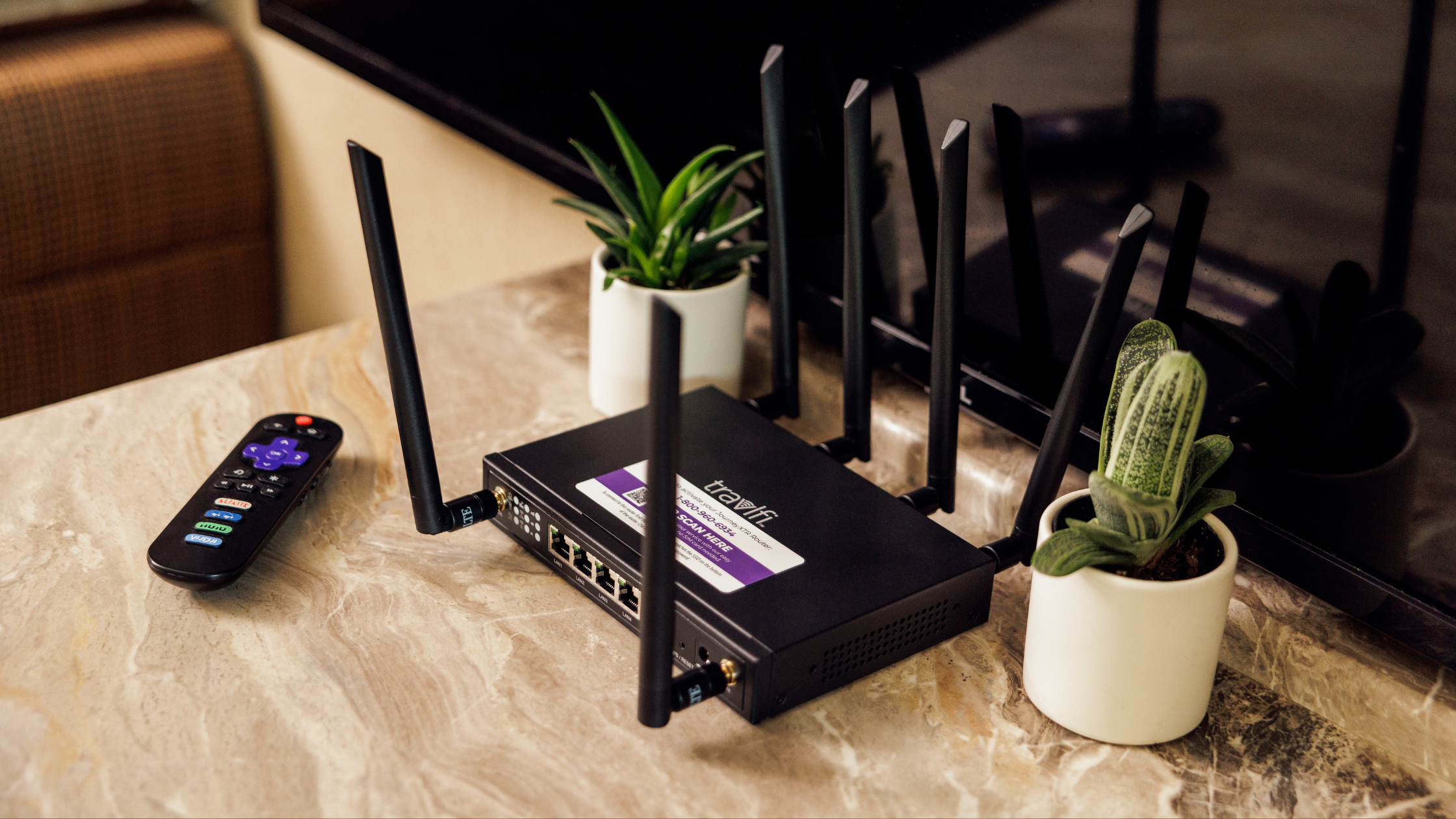
The TravlFi JourneyXTR is a 4G LTE RV Wi-Fi router and Wi-Fi extender in one. It's built with a metal shell that measures 180 x 130 x 30mm—about the size of a small book—and weighs under 1,500 grams. Even though it’s small, it boasts a Category 7 LTE modem with 2 high-gain MIMO LTE antennas for cellular signal and 4 MU-MIMO Wi-Fi antennas for device connectivity. That’s a lot of techy words, so let’s make it a little more approachable.
The JourneyXTR was designed for the RV traveler who needs more than a phone hotspot but doesn't need the full firepower (or price tag) of a 5G router. Jeff Gwinnell, TravlFi connectivity specialist, backs this up. “The JourneyXTR is for travelers who need enhanced networking capability in their RV or for general use,” he says. “The JourneyXTR has 4 LAN ports, 1 WAN port, and supports 32 connected users. The JourneyXTR is great for home office type operations, customers with more connected devices and those who need support for devices such as printers, PCs, fax machines, etc. As the JourneyXTR is a router at heart, it includes more customizable network functions, connects additional internet sources (via WAN port) and provides failover functionality too.”
TravlFi JourneyXTR Features
From connectivity to corrosion resistance, it’s time to dig into everything the JourneyXTR can do.
Connects to AC Power
Unlike the battery-powered and portable JourneyGo 4G hotspot, the JourneyXTR uses AC power via a 12V 1.5A DC adapter. While the JourneyGo is built to be tossed in a bag for portability, the JourneyXTR is built to be a more permanent part of your RV setup, meaning you just plug it in and leave it. But don’t worry, it won't annihilate your electrical budget because power consumption tops out at just 7 watts even when running all day.
Connectivity
The JourneyXTR works as a cellular router and a Wi-Fi extender. For the cellular part, the Cat 7 LTE modem boasts download speeds up to 300 Mbps. It also has 4 RJ45 Gigabit Ethernet LAN ports and 1 WAN Ethernet port, so you can hardwire devices like a desktop computer or smart TV for a more reliable connection. And in Wi-Fi extender mode, it can find a nearby Wi-Fi source (like public campground Wi-Fi) and rebroadcast it as a private signal inside your RV.
eSIM
eSIM technology means the router isn't locked to a single carrier. It automatically scans all major networks and connects to the strongest signal wherever you may be. If you're parked in Vermont where T-Mobile has the best service and then drive to New Hampshire where Verizon is stronger, the JourneyXTR handles that switch without your input. No SIM card swapping and no manual carrier selection, but you can find more details on the perks of eSIM in our full eSIM guide.
Carrier Compatibility
The JourneyXTR works with major U.S. carriers via its eSIM. That multi-carrier coverage is what beats out a single-carrier router or a phone hotspot that’s tied to your cell plan. So it’ll find the best signal among multiple networks.
Pay-As-You-Go Data Plans
TravlFi data plans are pay-as-you-go, so you don’t have to deal with contracts or commitments. You prepay for one month at a time based on how much data you need to accommodate your travel schedule. If you're parking the RV for winter, you can cancel your plan with no fees. When you hit the road again come spring, you can also reactivate at no additional charge. Plans start at $19/month for 4G LTE service.
Multi-Device Support
You can connect up to 32 devices to the JourneyXTR simultaneously. That's enough for two people with laptops, phones, and tablets all going at the same time, plus a streaming stick, smart speaker, and whatever other connected devices you've got continuously running in the rig. For most couples and solo full-timers, 32 devices is likely more than you’ll realistically need.
Water and Dust Resistance
The JourneyXTR's metal shell is much more durable than plastic-housed routers. While it's designed for indoor use, the rugged build is made to manage the vibrations, temperature swings, and dust that come with life in an RV. If you've ever had a flimsy piece of tech rattle pieces off after a few thousand miles, you'll know exactly what we’re talking about here.
TravlFi JourneyXTR Performance
The JourneyXTR's Cat 7 LTE modem is capable of download speeds up to 300 Mbps. But in reality, speeds typically land between 15 and 50 Mbps depending on your location, tower congestion, and how close you are to a cell tower. That's still enough for video streaming, Zoom calls, email, and browsing.
The 2 high-gain MIMO LTE antennas handle the cellular connection, and Gwinnell backs up the speeds and setup. “The JourneyXTR features external antennas for cellular and Wi-Fi—larger than the embedded antennas in your typical hotspot,” he says. “The external antennas provide enhanced cellular and Wi-Fi coverage, plus the ability to attach third-party antennas too. It works on the same 4G/LTE networks as other TravlFi 4G offerings, with typical download speeds from 1 to 60+ Mbps depending on conditions."
If you're regularly camping in fringe signal areas, like BLM land, or deep rural spots, pairing the JourneyXTR with a third-party antenna can make a big difference. The router has external antenna ports specifically for this, and TravlFi sells a mounting plate kit that's designed to work with the device.
As for a real-life use case, we’ve got you covered. Adventure Rocks tested the JourneyXTR through Washington, Montana, Nevada and Arizona, and reported 100% connectivity with speeds strong enough for streaming movies without buffering and handling email with no issues. Coming from a Winegard ConnecT 2.0, he called it a clear upgrade.
TravlFi Journey XTR vs Other TravlFi Devices
TravlFi makes a few different devices, and picking the right one comes down to how you travel and what you need. So let’s see how the JourneyXTR compares to the rest of TravlFi’s lineup.
JourneyGo 4G LTE Hotspot
The JourneyGo 4G is TravlFi's portable, battery-powered hotspot. It connects up to 10 devices, has a 16-hour battery, and fits in your pocket. It's great for weekend campers, day trips, and anyone who needs a basic grab-and-go connection. The JourneyXTR is a plug-in router supporting 32 devices, offering Ethernet ports, and doubling as a Wi-Fi extender. If you're a full-timer or travel with a partner, the XTR's extra capacity and always-on setup make more sense. If you're mostly solo and traveling light, the JourneyGo is the simpler, cheaper option.
JourneyGo 5G Hotspot
The JourneyGo 5G is TravlFi's more powerful portable hotspot, and it's definitely an upgrade from the 4G JourneyGo. It supports up to 16 devices (vs. the JourneyGo's 10), boasts a 24-hour battery, and runs on Wi-Fi 6 with speeds of 25-150 Mbps. If you want 5G speeds in a portable package, the JourneyGo 5G is truly hard to beat.
But the JourneyXTR still beats out a hotspot if you need a semi-permanent router setup. Its 32-device capacity, Ethernet ports, and Wi-Fi extender mode make it better for full-timers who want a single device wired into their rig that they don’t have to worry about forgetting to pack every time they hit the road. The JourneyGo 5G is for travelers who want fast, portable internet they can take outside of their RV.
JourneyXTR Pro 5G Router
The XTR Pro 5G is TravlFi's most powerful product. It has 5G capabilities with 4G LTE fallback, connects up to 128 devices, and delivers speeds of 4.76 Gbps. It's built for larger families, Xbox and PlayStation addicts, heavy streamers, and anyone running a full-time remote office from their RV.
The JourneyXTR covers most people's needs with 4G LTE and 32-device support and runs at a lower price point. The XTR Pro is the upgrade you make when you need max speed and capacity. But for small groups who don’t have 5G workloads, the JourneyXTR is definitely the better value option.
Where to Buy the TravlFi Journey XTR Router
You can buy the JourneyXTR from:
Snag a data plan with your router when you buy from TravlFi. You can also find the JourneyXTR Router Upgrade Kit if your RV came pre-wired for the device (found more often in newer Brinkley and Riverstone models).
FAQs About the TravlFi JourneyXTR Router
Is the TravlFi JourneyXTR worth it?
For solo RVers and couples who want RV internet without paying top-of-the-line prices for a 5G router, yes. It has multi-carrier connectivity via eSIM, 32-device support, pay-as-you-go plans, and Wi-Fi extension at a more manageable price point. If you need 5G speeds or have 100+ devices to connect, the JourneyXTR Pro 5G has you covered though.
How fast is the TravlFi JourneyXTR?
The Cat 7 LTE modem reaches speeds up to 300 Mbps. Real-world use speeds are more around 15-50 Mbps depending on your location, tower proximity, and network traffic.
Does the TravlFi JourneyXTR need a SIM card?
Nope, the JourneyXTR uses built-in eSIM technology to connect to all major cell networks automatically. Though there is a physical SIM slot if you want to add one (but it's not required for the device to work).
How many devices does the JourneyXTR support?
You can connect up to 32 devices. And its 4 Gigabit Ethernet LAN ports are built for hardwire connections, which is great for desktops or TV setups that thrive with that level of stability.
Can I use the JourneyXTR with an external antenna?
Yes. The JourneyXTR has external antenna ports and TravlFi sells a compatible external antenna with a mounting plate. Adding an external antenna is beneficial if you find yourself camping in weaker signal areas often—it can definitely boost speed and reliability.
More Essential Reading for RV Internet:
Which TravlFi Device Is Right for You?
TravlFi keeps you connected on the road. Not sure which device is best for you? Compare below.

If you’re ready to hit the road with reliable internet, learn how the JourneyXTR fits into your setup.





Share: